Get Out of Hand Meaning: How to Use This Common English Idiom Naturally
Simply put, “to get out of hand” means that a situation is spinning out of control. It’s the perfect phrase for those moments when something starts out perfectly normal but quickly turns into a chaotic, messy, or overwhelming situation.

- What Does "Get Out of Hand" Actually Mean?
- Is "Get Out of Hand" Formal or Informal?
- Examples of "Get Out of Hand" in a Sentence
- Common Phrases with "Get Out of Hand"
- The 'Helping Hand' That Got Out of Hand
- See It in Action: Real-Life Dialogue
- Watch Out: 5 Common Traps to Avoid
- Don't Confuse It With: Close But Different
- Up Your Vocabulary: 3 Smart Alternatives
- How to Say the Opposite
- Practice Time!
- Quick recap
What Does “Get Out of Hand” Actually Mean?
Imagine you’re at a birthday party. At first, everyone is having a great time. But then, more unexpected guests show up, the music gets blasted, someone accidentally breaks a chair, and the neighbors are already at the door complaining. At that exact moment, you’d probably lean over and say:
“Things are getting out of hand.”
This is the heart of the idiom. It describes a situation where you are losing your grip on control. Something starts out completely manageable but gradually becomes too chaotic, emotional, or just plain difficult to deal with.
While the literal words might make you think of something physically dropping from your hands, native speakers never actually picture that. Instead, they use it as a shortcut to say: “We’re losing control here.”
Think of it as your go-to expression when you want to warn someone that a situation is sliding into trouble, complain that things have gone too far, or explain why you need to step in and act fast before a minor issue turns into a major headache.
It works best as a natural part of a full sentence rather than a standalone, short answer. Look at how it flows here:
- The discussion got a bit out of hand.
- The kids are getting out of hand today.
- We seriously need to stop this before it gets out of hand.
Keep in mind: This idiom doesn’t mean a situation is ruined forever. It just means that control is slipping away right now – or is about to.
Is “Get Out of Hand” Formal or Informal?
The short answer is: it’s right in the middle.
This idiom is a perfect example of neutral, conversational English. It sounds completely natural in everyday speech and fits perfectly into most workplace contexts – from casual chats with colleagues to business meetings and emails. Since it’s not slang, anyone will understand you easily. Just keep in mind that it carries a bit of emotional weight, as it always signals that a situation has turned into a problem.
However, for formal academic papers or legal documents, it’s better to swap it for more direct, objective alternatives:
- The situation became difficult to control.
- The problem escalated.
- The situation became unmanageable.
Why intonation matters
Your tone of voice changes the meaning too. A calm “This is getting out of hand” usually shows genuine concern. But put a strong stress on the modifier – “This is REALLY getting out of hand” – and you instantly sound frustrated or dramatic. Either way, in everyday conversation, it remains your best go-to phrase for a situation that is slipping away from you.
Examples of “Get Out of Hand” in a Sentence
- The meeting got out of hand the moment two managers started arguing.
- Don’t let the problem get out of hand before talking to your boss.
- Our vacation expenses are getting out of hand – we seriously need a strict budget ASAP.
- The party was fun at first, but it quickly got out of hand when uninvited guests arrived.
- I thought the joke was funny, but it got out of hand and someone felt hurt.
- The comments on that video have completely gotten out of hand.
- Everything was under control yesterday, but today things are getting out of hand again.
- We should solve this now before it gets out of hand.
Common Phrases with “Get Out of Hand”
|
Common phrase |
Natural context (When to use it) |
|
Things are getting out of hand. |
To sound an immediate alarm when a current situation is spinning out of control. |
|
The situation got out of hand. |
To explain to someone what went wrong after a problem has already escalated. |
|
Don’t let it get out of hand. |
To give a strong piece of advice or a protective warning to a colleague or friend. |
|
Before it gets out of hand. |
To encourage early, decisive action before a minor issue turns into a major headache. |
|
Things have gotten out of hand. |
To describe an ongoing, messy problem that has been building up for some time. |
|
It quickly got out of hand. |
To emphasize that events changed at lightning speed (like a calm discussion turning into a fight). |
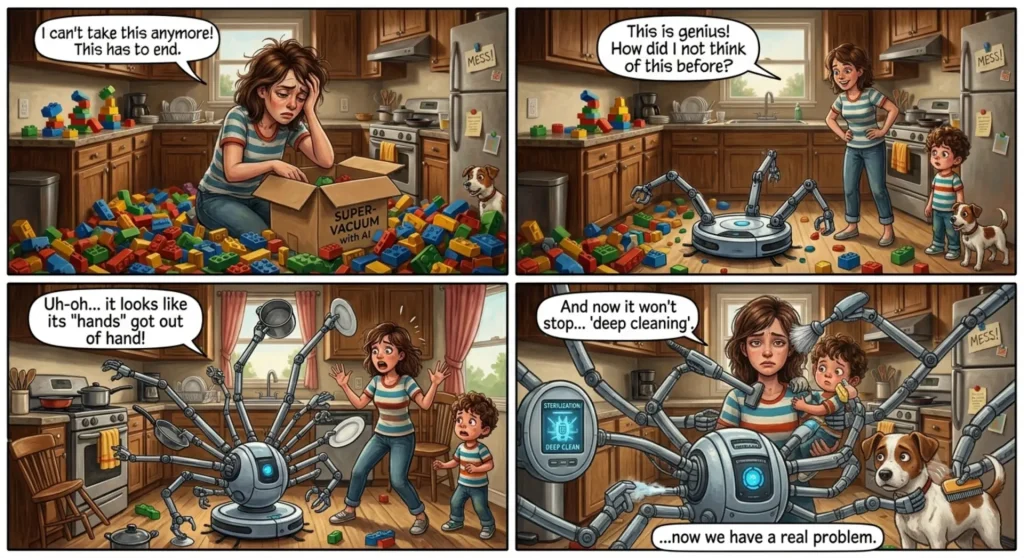
The ‘Helping Hand’ That Got Out of Hand
See It in Action: Real-Life Dialogue
Two coworkers are chatting right after a team meeting that went completely off the rails and became way more emotional than anyone expected.
- A: Well, that meeting was a complete disaster.
- B: Tell me about it. Everything started out fine, but it quickly got out of hand.
- A: Yeah, people just stopped listening and started shouting over each other just to win the argument.
- B: Exactly. Someone should’ve stepped in and changed the subject way earlier.
- A: Hopefully, we can smooth things over tomorrow.
- B: Yeah. It’s always easier to fix a mess before it completely gets out of hand.
Want more real English like this?
I share practical phrasal verbs, idioms, natural expressions, common mistakes, and short English quizzes on Telegram — in the same clear, everyday style.
Watch Out: 5 Common Traps to Avoid
Mistake 1
- ❌ The situation got out of hands.
- ✓ The situation got out of hand.
- What’s the catch? The phrase is locked. Even if a hundred people lose control of a situation, it is always hand (singular), never plural.
Mistake 2
- ❌ I got out of hand the meeting.
- ✓ The meeting got out of hand.
- What’s the catch? You don’t “do” this idiom to something else. The chaotic event (the meeting, the party, the protest) must be the main subject of your sentence.
Mistake 3
- ❌ The problem is getting out from hand.
- ✓ The problem is getting out of hand.
- What’s the catch? Don’t invent new links. The preposition is always of.
Mistake 4
- ❌ My manager is out of hand.
- ✓ The situation at work is getting out of hand.
- What’s the catch? Avoid using this to describe a person’s identity directly. Your boss isn’t “out of hand”—but their reactions, the workload, or the project definitely can be.
Mistake 5
- ❌ The project is out of my hands (when you mean it’s chaotic).
- ✓ The project got out of hand.
- What’s the catch? Don’t mix up these two completely different idioms:
- Out of my hands = “It’s no longer my responsibility / I can’t decide this anymore.”
- Get out of hand = “The situation is turning into a total circus and spinning out of control.”
Don’t Confuse It With: Close But Different
Get out of hand vs. Out of my hands
- The Difference: Get out of hand means a situation is turning into a chaotic mess. Out of my hands means you personally have zero control or responsibility over it anymore – it’s someone else’s problem.
- The discussion got out of hand during the meeting. (It became loud and chaotic).
- The final decision is out of my hands now. (I can’t change it even if I wanted to).
Get out of hand vs. Go too far
- The Difference: Go too far usually focuses on a specific person’s bad behavior or an offensive joke that crossed the line. Get out of hand focuses on the whole situation spinning out of control.
- His political joke went too far and upset people. (The joke itself was unacceptable).
- The whole conversation got out of hand. (Everyone started arguing, not just one person).
Up Your Vocabulary: 3 Smart Alternatives
Get out of control (The Direct Alternative)
- When to use: When you want to sound a bit more literal and direct. It works perfectly for both physical things (like fires or crowds) and abstract situations.
- The fire quickly got out of control.
Spiral out of control (The Dramatic Choice)
- When to use: Use this when a situation isn’t just getting bad – it’s getting worse and worse at lightning speed, like a snowball rolling downhill.
- Production costs began to spiral out of control.
Get carried away (The Emotional One)
- When to use: This one is about people, not situations. Use it when someone gets too excited, emotional, or overenthusiastic and loses their common sense for a moment.
- I got carried away at the mall and spent my whole paycheck.
How to Say the Opposite
Be under control (The State)
- Don’t worry, everything is under control now.
Get/Bring something under control (The Action)
- It took us two hours, but we finally got the situation under control.
Practice Time!
1. Spot the Trap
The argument between the dark-haired manager and the designer ________ before anyone could stop them.
- a) got out of hands
- b) got out of hand
- c) went out of hand
2. Right Time, Right Form
Fix the sentence below. (Hint: The trouble with the budget is happening right now, so use the correct verb tense!)
“We need to stop spending money. Our project costs get out of hand this month.”
3. The Ultimate Showdown
Choose the correct idiom for this context:
“I really want to help you with your work schedule, but I don’t have the authority. The final decision is completely [ out of my hands / getting out of hand ] now.”
4. Make It Sound Natural
Rewrite this text-book sentence using a pattern with get out of hand:
“We should call a technician immediately, because the server issues are starting to become impossible to manage.”
5. Fact Check
Is this sentence natural? Why or why not?
“I can’t clear my inbox, my emails are completely out of hands!”
Answer key:
- b) got out of hand (Remember, the idiom is locked in the singular form and always uses “of”, never “out of hands” or “went out of hand”).
- are getting out of hand (Since it’s a process happening right now this month, we need Present Continuous).
- out of my hands (Context check! This means “I have no control/responsibility anymore,” not that the situation is messy or chaotic).
- …before they get out of hand. (Your natural rewrite should look like this: “We should call a technician before the server issues get out of hand” or “…before things get out of hand”).
- No, it’s wrong. (Two mistakes here: first, it must be “out of hand” (singular). Second, emails themselves don’t get out of hand – the situation with your inbox does. It’s better to say: “The email situation is getting out of hand!”).