
Tell Me About It Meaning: Why This Phrase Doesn’t Always Mean “Tell Me More”
Short meaning: “Tell me about it” may look like a request for a story, but as a spoken expression it often means, “I know exactly what you mean – this is familiar to me too.”

- Why “Tell Me About It” Usually Means the Opposite
- Grammar Notes: How “Tell Me About It” Works
- Tone: Casual, Natural, Sometimes Dry
- Mini Dialogue: When “Tell Me About It” Means “Same Here”
- When Monday Strikes
- Mistakes to Avoid with “Tell Me About It”
- Don’t Mix It Up with “Tell Me More”
- Practice: Would You Really Say “What’s the Catch?”
- Quick recap
Why “Tell Me About It” Usually Means the Opposite
Imagine this: someone says, “I barely slept last night,” and you answer, “Tell me about it.”
You are not really asking them to describe their night. You are saying, “Same here. I know exactly how that feels.”
That is the tricky part of the tell me about it meaning. The words look like a request: “Please explain it to me.” And sometimes they really do mean that:
“You got a new job? Tell me about it!”
But in everyday spoken English, Tell me about it! is often a reaction, not a question. It usually means:
“I know.”
“I completely understand.”
“That happened to me too.”
“You don’t need to explain — I already get it.”
So when someone says, “This traffic is awful,” and you answer, “Tell me about it,” you mean, “Yes, I’m dealing with it too.” It is a short way to show agreement, shared frustration, or shared experience.
Is tell me about it idiom or just a phrase? It can be called an idiom because the meaning is not fully literal. It is also a fixed expression because the words usually stay the same in this spoken meaning.
Grammar Notes: How “Tell Me About It” Works
In the literal meaning, the grammar is normal and flexible:
Tell me about your trip.
Can you tell me about the meeting?
Tell us about your new job.
She told me about the problem yesterday.
Here, tell really means “give information,” so you can change the object, tense, or add more details.
But in the idiomatic meaning, the phrase is almost fixed:
“This weather is awful.” — “Tell me about it.”
“Work has been so stressful.” — “Tell me about it!”
In this use, do not change the words too much. Tell me about it works as one short reaction, like I know or Exactly.
The punctuation changes the feeling:
- Tell me about it! sounds more emotional, usually because the speaker strongly agrees or shares the frustration.
- Tell me about it. with a period can sound calmer, tired, or dry.
One more useful point: it usually refers to the situation already mentioned.
“Rent is so expensive now.” — “Tell me about it.”
Here, it = the problem of expensive rent.
Tone: Casual, Natural, Sometimes Dry
It is a casual expression, so it works best in friendly conversation, quick messages, and everyday complaints — not in formal writing.
Tone matters. Said warmly, it means “I understand.” Said with a tired smile, it means “Same problem here.” Said flatly, it can sound dismissive: “Yeah, I know.”
“Customer service kept me on hold for forty minutes.” — “Tell me about it!”
Mini Dialogue: When “Tell Me About It” Means “Same Here”
Two colleagues are having lunch after a long morning of calls and emails.
- Maya: I spent forty minutes on the phone with customer service, and they still didn’t fix the problem.
- Leo: Tell me about it.
- Maya: Oh no. You had to call them too?
- Leo: Twice this week. First they transferred me to billing, then billing sent me back to support.
- Maya: That is exactly what happened to me.
- Leo: And somehow the bill is still higher than last month.
- Maya: Of course it is. Next time I call them, I’m making coffee first.
Want more real English like this?
I share practical phrasal verbs, idioms, natural expressions, common mistakes, and short English quizzes on Telegram — in the same clear, everyday style.
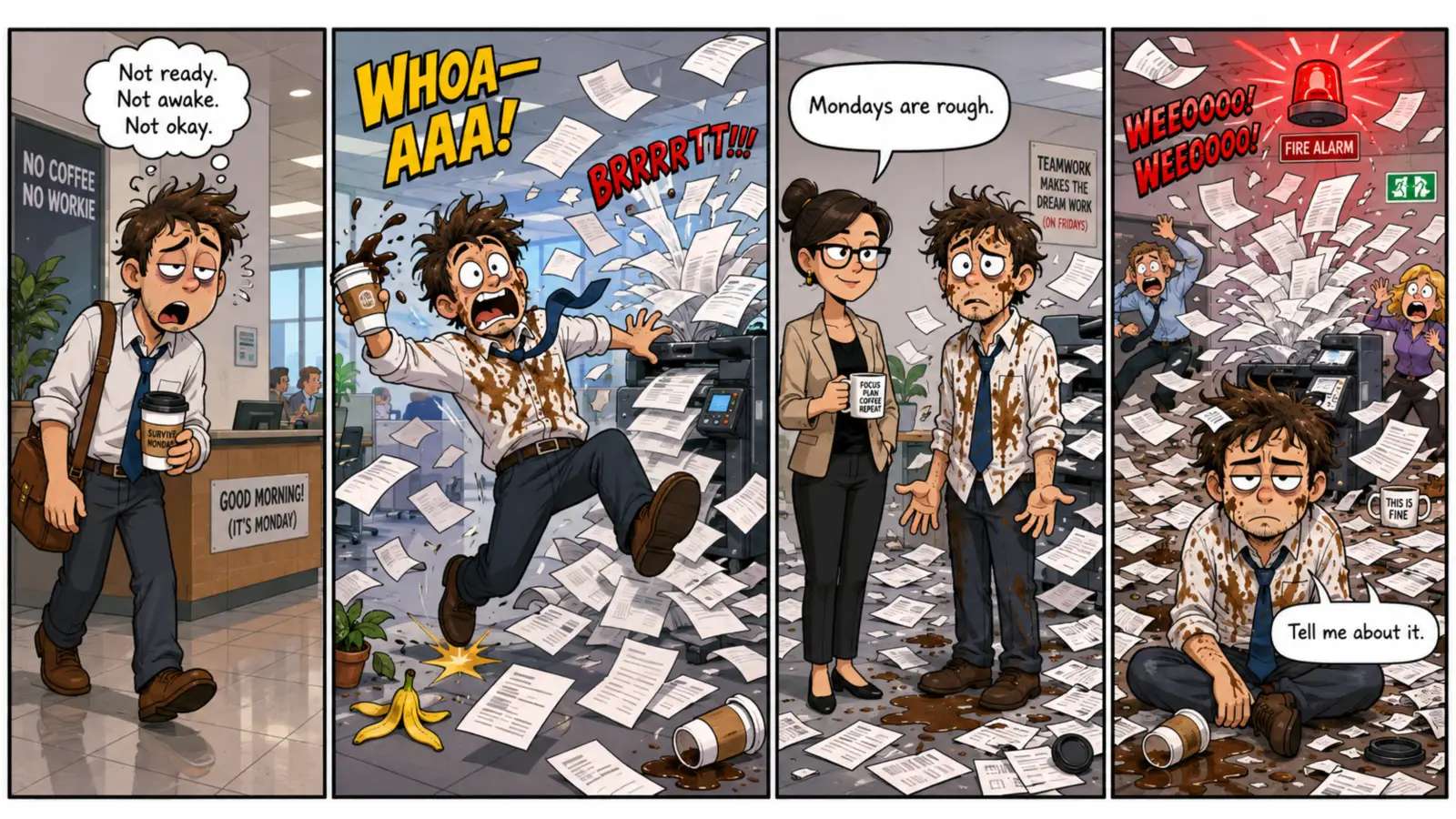
When Monday Strikes
Mistakes to Avoid with “Tell Me About It”
- Thinking it means “please explain” after a complaint
- Wrong understanding: “This traffic is terrible.” – “Tell me about it.”
= “Please describe the traffic to me.” - Correct understanding:“This traffic is terrible.” – “Tell me about it.”
= “I know. I’m stuck in the same situation too.” - After a complaint, Tell me about it usually works as a short reaction of agreement: “I know exactly what you mean.” You can use it alone, or add your own experience: “Tell me about it. I’ve been sitting in this traffic for thirty minutes.”
- Adding “more” when you mean “I agree”
- Wrong: “This course is so hard.” – “Tell me more about it!”
- Correct: “This course is so hard.” – “Tell me about it!”
- Tell me more about it asks for extra information.
- Using it where the tone is too serious
- Wrong: “My grandmother died last night.” – “Tell me about it.”
- Correct: “I’m so sorry. That must be very hard.”
- The expression works best with shared everyday problems: traffic, prices, work stress, bad weather, slow service. With painful personal news, it can sound too casual, or as if you are pulling the attention back to your own experience.
Don’t Mix It Up with “Tell Me More”
The main confusion is with Tell me more about it and Tell me all about it. Both usually mean: “I’m interested – keep talking.”
You started a new job? Tell me more about it.
Here, the person wants extra details.
You went to Italy? Tell me all about it!
This sounds even more interested or excited, like: “I want the full story.”
Tell me about it is different when it comes after a complaint:
This rent is ridiculous. – Tell me about it.
Here, it does not mean “continue.” It means “I know. I’m dealing with the same thing.”
Practice: Would You Really Say “What’s the Catch?”
Does it work here?
Read each situation. Decide if Tell me about it sounds natural or not. If it does not sound natural, explain the problem in one short sentence.
- “The train was packed again this morning.” – “Tell me about it. I could barely move.”
- “I’m moving to Canada next month.” – “Tell me about it.”
- “My boss changed the deadline at 5 p.m. on Friday.” – “Tell me about it. That happened to us last week.”
- “My dad is having surgery tomorrow.” – “Tell me about it.”
- “This app logs me out every five minutes.” – “Tell me about it. Mine does the same thing.”
Which reply sounds more natural?
Choose the better reply. Pay attention to whether the speaker really shares the problem.
1.“Rent is so expensive now.”
A. “Tell me about it. Mine went up again this year.”
B. “Tell me about it. I live rent-free with my parents and have no idea.”
2.“The new schedule is exhausting.”
A. “Tell me about it. I’ve been leaving work late all week.”
B. “Tell me about it. I’m going on holiday tomorrow.”
3.“The website crashed right before I paid.”
A. “Tell me about it. Their site is always a mess.”
B. “Tell me about it. I love websites.”
Choose the best response
Choose the response that fits the tone best.
1.Your friend says: “I failed the driving test again.”
A. “Tell me about it.”
B. “That’s really frustrating. I’m sorry.”
C. “You can say that again.”
2.Your coworker says: “This meeting could have been an email.”
A. “Tell me about it.”
B. “Tell me about the meeting in detail.”
C. “I’m sorry for your loss.”
3.Your classmate says: “I finally finished my project!”
A. “Tell me about it. My printer broke too.”
B. “Nice! How did it go?”
C. “Tell me about it. I know exactly what you mean.”
Answer key:
- 1) Natural; 2) Not natural as the idiom – because moving to Canada is news, so the phrase sounds like a request for the story; 3) Natural; 4) Not natural – because serious family news needs care, not a casual shared-frustration phrase; 5) Natural – because Tell me about it works best after ordinary shared problems.
- 1) A; 2) A; 3) A – because the natural answer shows a real similar experience, not a random or opposite situation.
- 1) B; 2) A; 3) B – because the phrase fits light shared frustration, but disappointment or good news often needs a more personal response.

