Lose My Cool Meaning: More Than Just “Getting Angry”
“Lose my cool” means to stop staying calm and become angry, upset, or emotionally uncontrolled. It is the first-person form of the idiom “lose your cool.”
Example: “I lost my cool when the airline canceled our flight again.”
The possessive word changes depending on the person: my, your, his, her, our, or their. The verb can also change: lose, lost, or losing.

- When Do We Use “Lose My Cool”?
- “Lose Your Cool” Meaning in Simple English
- Tone and Usage: Is “Lose My Cool” Formal or Informal?
- Natural Patterns with “Lose My Cool”
- Mini dialogue: “Lose my cool” in context
- In real life, it looks something like this
- Common Phrases with “Lose Your Cool”
- Avoid this mistake
- Don’t Confuse It With: Similar Expressions & Traps
- Similar Expressions: Lose My Cool vs Blow Up
- Opposite Expressions: How to Say “Stay Calm”
- Practice “Lose Your Cool”
- Quick recap
When Do We Use “Lose My Cool”?
This idiom perfectly describes that exact moment when your patience finally runs out. It is used when someone genuinely tries to stay calm, but a situation becomes too stressful, annoying, or unfair.
At first, a person might control their reaction—they speak politely, smile, and wait patiently. But as time goes on, the pressure builds up. Imagine a colleague interrupting you for the fifth time, a flight getting delayed yet again, or someone making the exact same mistake over and over. Your irritation grows until one final, tiny annoyance becomes the last straw.
When you finally lose your cool, your hidden frustration becomes visible to everyone around you. You might raise your voice, snap at someone, send a sharp message, or say something you will later regret.
🏨 Real-Life Case: The Hotel Nightmare
Imagine you’ve been waiting at a hotel reception desk for almost an hour after a long, exhausting flight. The staff keep checking their computers, giving you fake smiles, and repeating: “Just five more minutes, please.”
Suddenly, they look up and calmly tell you that your room isn’t actually ready at all. You tried your best to stay polite and professional, but this is too much. You completely lose your cool and start demanding to see the manager.
“Lose Your Cool” Meaning in Simple English
To truly understand the Lose Your Cool meaning in simple English, we need to look at one important rule: this idiom does not simply mean “to feel angry.”
You can easily feel furious on the inside while remaining completely quiet on the outside. However, the moment someone loses their cool, that hidden emotion flashes to the surface. It is a visible, audible reaction that everyone around them can immediately see or hear.
Take a look at this everyday example:
✈️ “I lost my cool when the airline canceled our flight for the second time.”
This doesn’t just mean the speaker was unhappy. It tells us they likely became visibly upset – perhaps they complained loudly to the staff, raised their voice, or spoke much more sharply than usual.
Keep in mind that the word cool in this context means calm, relaxed, and emotionally in control. It has absolutely nothing to do with being fashionable, stylish, or popular. So, the phrase never means “to stop being trendy.” It strictly means “to lose your emotional balance.”
Why Not Just Say “Get Angry”?
Native speakers prefer this idiom over a basic phrase like “get angry” because it captures a highly specific moment in time. It shows a dramatic breaking point.
“I lost my cool” – This visually shows the exact second your calm control completely broke under pressure.
“I got angry” – This simply names the emotion you are feeling.
Tone and Usage: Is “Lose My Cool” Formal or Informal?
This expression is highly conversational, common, and perfectly safe for everyday speech. It isn’t rude or vulgar, but it sits firmly in the middle of the informal scale. It sounds incredibly natural in personal stories, social media posts, and relaxed workplace chats.
You can easily use lose your cool both with close friends and colleagues, but there is one golden rule to keep in mind: be careful when applying it to someone else. Because this idiom describes a visible emotional explosion, using it to describe a coworker or a boss can sound a bit critical or judgmental.
Let’s look at the difference in tone:
- 📱 With Friends (Safe & Natural):
- “I nearly lost my cool when my screen completely froze right in the middle of making an online payment.”
- 💼 At Work (Conversational but Sharp):
- “He lost his cool during the marketing meeting, but luckily, he apologized to the team later.”
The Corporate Alternative
If you are writing a formal business email, an official report, or a serious message to a client, it is much safer to avoid theater and street slang entirely. To keep your communication professional, replace the idiom with one of these neutral alternatives:
- 🏢 “He became rather frustrated during the morning session.”
- 🏢 “The conversation became a bit tense.”
- 🏢 “She reacted somewhat emotionally to the feedback.”
A Secret Weapon for Speaking Exams
If you are preparing for international English exams (like IELTS or Cambridge B1/B2 tests), this idiom is an absolute goldmine! Examiners love it when you use natural expressions to describe feelings. Drop lose my cool into the speaking section whenever you are asked to talk about stress, unexpected travel problems, family conflicts, or workplace pressure.
Note: Keep it strictly for the speaking test! In the academic writing section, always stick to formal terms like “lose self-control” or “become frustrated.”
Natural Patterns with “Lose My Cool”
|
Pattern |
How to Use It |
Real-Life Example |
|
lose + my / your / his / her / their + cool |
Use it when you want to say who became emotionally uncontrolled in general or in the present. |
🧘♂️ “I try not to lose my cool when people are rude to me.” |
|
lost + possessive adjective + cool |
Use it when you describe a past emotional reaction. |
📝 “She lost her cool after the third mistake in the report.” |
|
don’t / didn’t / never lose your cool |
Use it when you give advice to someone or describe standard self-control. |
🛑 “Don’t lose your cool just because someone disagrees with you.” |
|
almost / nearly lost my cool |
Use it when someone came close to reacting angrily but managed to stay controlled. |
📱 “I almost lost my cool when the app crashed again.” |
|
lose your cool with someone |
Use it when the emotional reaction is directed at a specific person. |
📞 “He lost his cool with the receptionist after waiting for an hour.” |
|
lose your cool over something |
Use it when you want to explain the specific reason or trigger for the reaction. |
🌐 “Don’t lose your cool over one negative comment online.” |
|
What makes you lose your cool? |
Use it when you ask someone about their emotional triggers. |
⚡ “What makes you lose your cool at work?” |
Mini dialogue: “Lose my cool” in context
Two coworkers, Maya and Daniel, talking in the office kitchen right after a very stressful Zoom call with a difficult client.
- Maya (looking concerned): Hey Daniel, you looked completely stressed out after that call. Is everything okay? What happened?
- Daniel (sighing): Oh, you wouldn’t believe it. The client completely changed the project brief again and then had the nerve to say we should have expected it!
- Maya: Wow, that sounds incredibly frustrating. Did you manage to stay calm?
- Daniel: Honestly, I tried my best. But the moment they started blaming our team for the delay, I almost lost my cool.
- Maya (raising her eyebrows): Almost?
- Daniel: Yeah… I didn’t shout or anything, but my tone definitely got way sharper than usual.
- Maya: I totally understand, anyone would feel that way. Still, maybe take a quick break and send them a calm follow-up email before this turns into a massive conflict.
- Daniel (taking a deep breath): Good idea. I really don’t want to lose my cool with a client again. It’s just not professional.
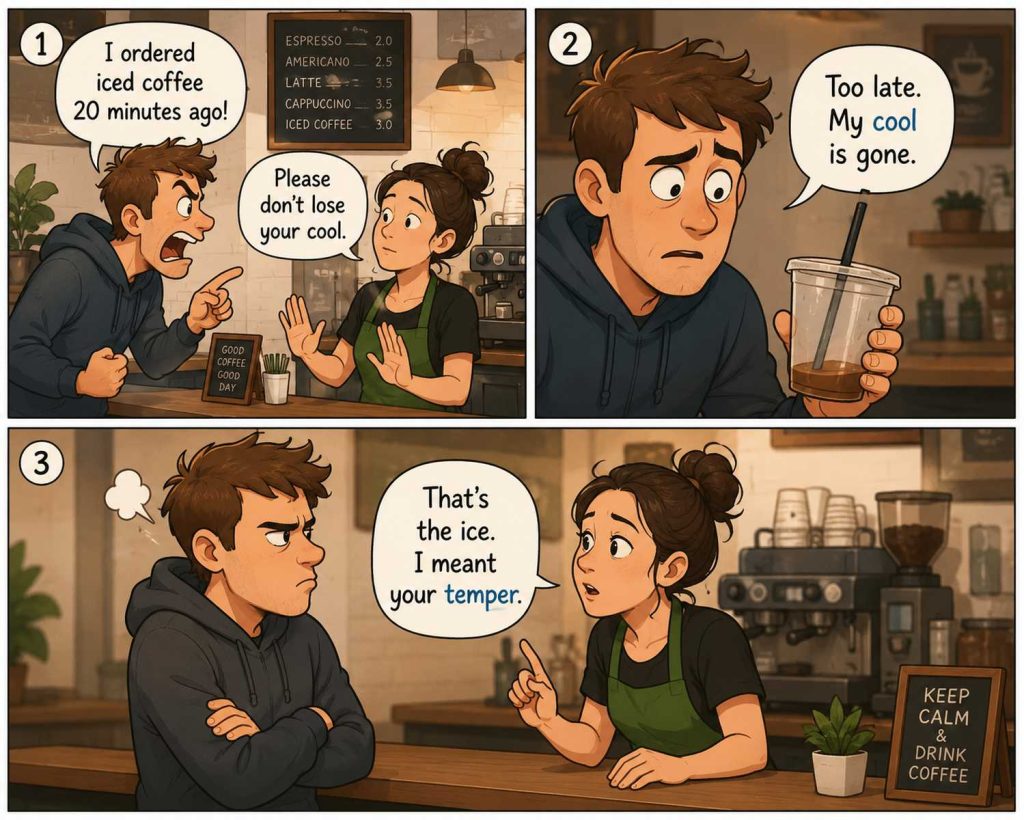
In real life, it looks something like this
Common Phrases with “Lose Your Cool”
| Common phrase | Natural context |
|---|---|
| lose your cool | stop staying calm and react with anger, stress, or frustration |
| lose my cool | talking about your own emotional reaction |
| lose his cool | describing a man who stopped staying calm |
| lose her cool | describing a woman who stopped staying calm |
| lose their cool | describing people who stopped staying calm |
| lost my cool | talking about a past moment when you reacted emotionally |
| almost lost my cool | came close to reacting angrily but maybe stayed controlled |
| nearly lost my cool | almost reacted emotionally because of stress or irritation |
| don’t lose your cool | advice to stay calm in a stressful or annoying situation |
| try not to lose your cool | advice or self-control before reacting |
| make someone lose their cool | cause someone to stop staying calm |
| lose your cool with someone | react angrily or sharply toward a person |
| lose your cool over something | react emotionally because of a problem, comment, delay, or mistake |
| lose your cool at work | stop staying calm in a work situation |
| lose your cool in public | react emotionally where other people can see it |
| keep your cool | stay calm; the opposite of lose your cool |
Want more real English like this?
I share practical phrasal verbs, idioms, natural expressions, common mistakes, and short English quizzes on Telegram — in the same clear, everyday style.
Avoid this mistake
Dropping or Changing the Pronoun (The “Article Trap”)
- ❌ Wrong: “I lost the cool during the meeting.” or “He lost cool when they criticized him.”
- Correct: “I lost my cool during the meeting.” / “He lost his cool when they criticized him.”
- Why: You can never use articles like a or the, and you cannot leave a blank space. This idiom strictly requires a possessive adjective that matches the person (my, your, his, her, our, their).
Forgetting the Past Tense
- ❌ Wrong: “Yesterday I lose my cool with my colleague.”
- Correct: “Yesterday I lost my cool with my colleague.”
- Why: If the emotional explosion happened in the past and is already over, you must change the irregular verb lose to lost.
Translating Word-for-Word
- ❌ Wrong: “I lost my cold when the waiter was rude.”
- Correct: “I lost my cool when the waiter was rude.”
- Why: Idioms are a package deal – you cannot translate them literally! In this phrase, the word cool has a unique meaning of “calmness and self-control.” It has absolutely nothing to do with low temperatures, so swapping it for cold makes no sense to a native speaker.
Using the Wrong Preposition
- ❌ Wrong: “She lost her cool on the assistant.”
- Correct: “She lost her cool with the assistant.”
- Why: This is a classic mistake because many languages use the preposition “on” here. However, in English, whenever your negative emotional reaction is directed at a specific person, you must always use with someone.
Don’t Confuse It With: Similar Expressions & Traps
The Slang Trap: Cool = Fashionable or Stylish
- 🧠 The Mistake: Believing that “He lost his cool” means someone stopped being trendy or popular.
- 🎯 The Reality: In everyday modern English, cool often means impressive or stylish. However, inside this specific idiom, cool strictly means calmness and emotional self-control. It has absolutely nothing to do with fashion.
- 💬 Example: “He completely lost his cool when the waiter ignored him for twenty minutes.” (He didn’t become unfashionable; he simply got furious).
Lose Your Cool vs. Lose Your Temper
- 🧠 The Mistake: Thinking these two mean exactly the same thing.
- 🎯 The Reality: They are incredibly close, but there is a tiny, important difference. Lose your temper focuses directly and deeply on aggressive anger (screaming, shouting, slamming doors). Lose your cool is broader – it simply means your calm control broke, even if you just reacted with a sharp, freezing tone without shouting.
- 💬 Example: “She lost her cool during the call, but she managed not to shout at anyone.”
Lose Your Cool vs. Lose It
- 🧠 The Mistake: Using them interchangeably in any situation.
- 🎯 The Reality: Lose it is much more informal and carries a wider range of emotions. While lose my cool is mostly about anger or heavy frustration, lose it can mean bursting into tears, laughing uncontrollably when you shouldn’t, or feeling completely overwhelmed by stress.
- 💬 Example: “I nearly lost it and started crying when I saw the final bill.”
The Direct Opposite: Keep Your Cool
- 🧠 The Mistake: Mixing up the verbs and thinking they share a similar meaning.
- 🎯 The Reality: This is the exact antonym (opposite phrase). To keep your cool means to successfully stay relaxed, professional, and completely calm, even under immense pressure.
- 💬 Example: “She beautifully kept her cool even when the customer became incredibly rude.”
Similar Expressions: Lose My Cool vs Blow Up
⚡ Snap (The “Broken Patience” Moment)
- Vibe: Conversational & common.
- The Difference: While lose my cool is a general phrase, snap specifically describes a quick, sharp reaction that happens after you have been patient for a long time. It’s the exact moment your emotional rubber band breaks.
- Example: “She finally snapped and told everyone to stop interrupting her.”
🌪️ Fly off the handle (The Dramatic Overreaction)
- Vibe: Informal idiom.
- The Difference: This is much stronger, louder, and more dramatic than lose my cool. It usually suggests that someone completely lost control and overreacted to a very minor problem.
- Example: “Don’t fly off the handle before you hear the full story.”
💥 Blow up (The Loud Explosion)
- Vibe: Informal phrasal verb.
- The Difference: This is highly intense. Unlike lose my cool (which can be quiet and icy), blow up almost always involves a loud explosion of anger, shouting, or slamming doors.
- Example: “The manager blew up when he saw the terrible mistake in the final report.”
💼 Lose your composure (The Formal Twin)
- Vibe: Formal / Neutral.
- The Difference: This is your best choice for business letters, essays, or academic contexts. It means to stop appearing calm and collected. Unlike lose your cool, it can describe not just anger, but also bursting into tears, sudden panic, or deep embarrassment.
- Example: “The speaker lost her composure during the emotional interview.”
Opposite Expressions: How to Say “Stay Calm”
🧘♂️ Stay calm (The Universal Choice)
- Vibe: Neutral, simple, and very common.
- The Nuance: This is the most natural, everyday alternative to keep your cool. It is perfectly safe to use with friends, family, or colleagues.
- Example: “Try to stay calm and explain exactly what happened.”
📋 Remain calm (The Official Tone)
- Vibe: Slightly more formal.
- The Nuance: Because of the verb remain, this phrase sounds a bit more serious and polished. You will often hear it in official announcements, professional settings, or serious situations.
- Example: “Passengers were asked to remain calm during the flight delay.”
🛑 Keep calm (The Piece of Advice)
- Vibe: Everyday English / Instructions.
- The Nuance: This phrase is most frequently used when giving direct advice, emotional support, or instructions to someone who is currently feeling stressed.
- Example: “Keep calm and don’t reply to that email while you’re still angry.”
💎 Remain composed (The Elegant Alternative)
- Vibe: Formal and sophisticated.
- The Nuance: This is a beautiful high-level phrase. It means not only staying calm on the inside, but also looking completely controlled, professional, and elegant on the outside. Perfect for business and exams!
- Example: “She beautifully remained composed throughout the entire difficult conversation.”
Practice “Lose Your Cool”
Ready to test yourself?
Complete a short interactive quiz and check whether you can use “lose your cool” correctly in real-life situations.
7 questions · Instant feedback · About 2 minutes