Stop Putting It Off: The “Bite the Bullet” Meaning and How to Use It
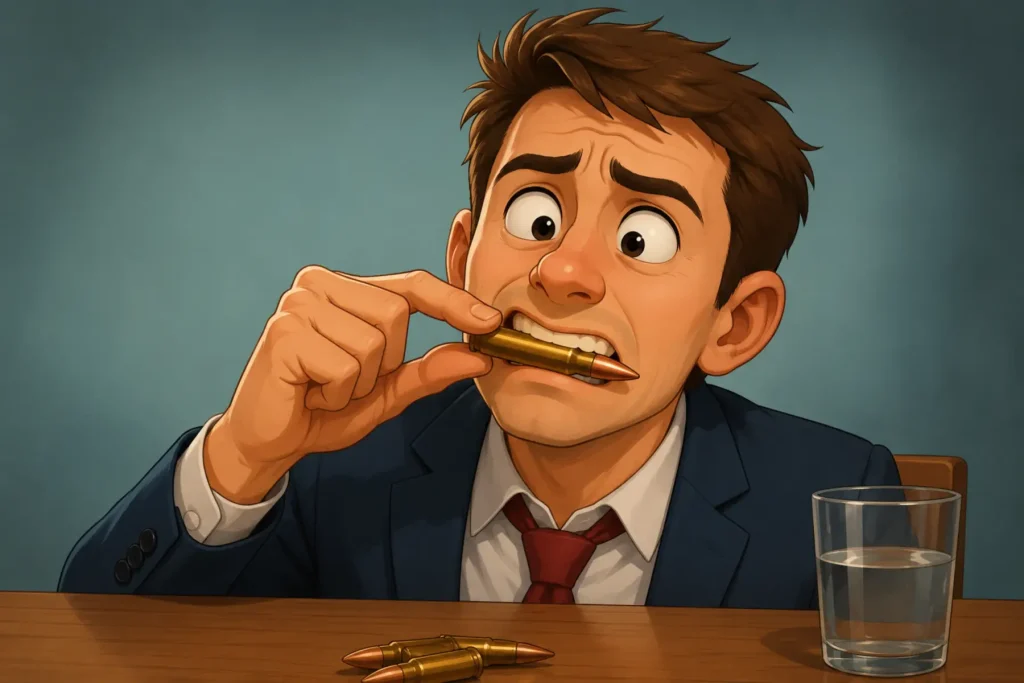
The bite the bullet meaning is to force yourself to face a difficult, painful, or unpleasant situation with courage because avoiding it is no longer an option.
- What "Bite the Bullet" Means
- When to Use "Bite the Bullet" in English
- The Golden Rule: It Must Be Unpleasant
- Formal or Informal: Finding the Right Tone
- Everyday Life Examples: From Teeth to Tech
- Common Patterns: How to Use "Bite the Bullet" in Everyday Conversation
- The IKEA Battle: Bite the Bullet
- Bite the Bullet Conversation: Facing an Uncomfortable Talk
- Bite the Bullet Correctly: Avoid These Common Mistakes
- Don’t Confuse "Bite the Bullet" with These Expressions
- Expanded Vocabulary: "Bite the Bullet" Synonyms and Alternatives
- The Flip Side: Useful Contrast Expressions
- Check Your Progress: Practice Exercises
- Quick recap
What “Bite the Bullet” Means
If you’re wondering what “bite the bullet” means, think about a situation where you know something unpleasant is waiting for you, but you decide to face it anyway. The idiom does not simply mean “to be brave” – it has a much more specific focus.
Imagine your laptop has been making strange noises for weeks. You keep hoping it will fix itself, but one morning it won’t even turn on. You know buying a new one will be expensive, but you absolutely need it for work. Finally, you order it and tell your friend: “I had to bite the bullet.” That is the heart of the expression — the literal image is biting a real bullet, but today the phrase is understood purely as a fixed idiom.
The meaning of the phrase always includes three important elements:
- There is something you really don’t want to do;
- You know it is absolutely necessary;
- You finally force yourself to do it.
Once you take action, you usually feel relieved. The task itself may still be unpleasant, but the stressful waiting is finally over.
Notice that the idiom is always used as part of a larger sentence rather than as a standalone response. It does not mean that something bad happened unexpectedly, nor does it mean being completely fearless. The focus is always on accepting an unavoidable action:
- I finally bit the bullet and called my boss.
- We had to bite the bullet and replace the washing machine.
- She’ll have to bite the bullet sooner or later.
When to Use “Bite the Bullet” in English
Understanding how to use “bite the bullet” becomes much clearer when you look at what happens before the idiom is even spoken.
Usually, someone has been delaying an uncomfortable decision for days, weeks, or months. They might feel nervous, worried about money, or afraid of the outcome, but they eventually realise that waiting only makes things worse. That is the exact moment when this idiom sounds completely natural.
For example, imagine two friends chatting after work. One has been complaining for weeks about a painful tooth:
- “Have you made a dentist appointment yet?”
- “No… but I think I’ll bite the bullet tomorrow.”
Nobody expects a root canal to be fun. The phrase highlights the emotional shift of finally making that tough choice.
Here are the most common everyday situations where you will hear it:
- Financial stress: Paying for an expensive car repair instead of hoping the noise goes away.
- Tough conversations: Apologising after an argument or telling someone an uncomfortable truth.
- Life changes: Leaving a job that no longer makes you happy or booking an appointment you’ve been avoiding.
This expression is equally popular in professional environments when leaders face unavoidable budget cuts or layoffs. For instance, a manager might say: “We’ll have to bite the bullet and reduce our marketing budget this quarter.”
The Golden Rule: It Must Be Unpleasant
If an action is exciting, positive, or fun, using this idiom will sound completely wrong to native speakers:
- ❌ I bit the bullet and booked my dream vacation to Japan. (Unnatural – booking a holiday is something people enjoy).
- ✅ I bit the bullet and paid for emergency flights after my original connection was cancelled. (Perfect – this is a stressful, expensive, and forced decision).
Formal or Informal: Finding the Right Tone
Native speakers use it comfortably in everyday conversations, text messages, workplace discussions, and emails between colleagues. Because it is so common, it never sounds strange in spoken English and can even make advice sound warmer and more supportive.
Compare these two options:
- “You need to pay for the repairs.”
- “You may just have to bite the bullet and pay for the repairs.”
The second version feels much more understanding because it directly recognises that the decision is unpleasant.
However, you should avoid overusing the idiom in strictly formal writing, academic essays, or legal documents. In those contexts, direct expressions like accept the cost, make the difficult decision, or take the necessary action are much more appropriate.
A Note on Tone: Don’t Be Too Dramatic
While the phrase is never rude, it can sound overly dramatic if the problem is too trivial. For example, saying, “I had to bite the bullet and answer one email,” sounds highly exaggerated unless that email was incredibly difficult to write. But if the message contains a tough apology or a resignation, the idiom immediately fits perfectly.
Everyday Life Examples: From Teeth to Tech
These bite the bullet sentence examples show how native speakers naturally use the expression in everyday life:
- After comparing prices for weeks, I finally bit the bullet and bought a new phone.
- My sister absolutely hates dentists, but she finally bit the bullet and booked an appointment.
- Instead of arguing further, he bit the bullet, admitted he was wrong, and apologized.
- We kept putting off the question of whether we should just bite the bullet and replace the broken washing machine.
- Text message: I’ve been avoiding that phone call all week, but I’m going to bite the bullet right after lunch!
Work & Career Contexts
In professional environments, this phrase describes facing tough corporate realities or awkward business choices:
- We knew the meeting would be uncomfortable, but we had to bite the bullet and tell the client the truth about the delay.
- The creative team didn’t like the idea of changing the schedule, but everyone agreed it was time to bite the bullet.
- Sometimes the hardest part of a project isn’t the task itself — it’s simply deciding to bite the bullet and get started.
Advanced Grammar: Watching the Verb Change
Remember, bite is an irregular verb. Pay close attention to how it changes in different tenses:
- Past Simple: I kept putting the assignment off until Sunday evening. Then I bit the bullet and finished it in one night.
- Present Perfect: He still hasn’t bitten the bullet, even though everyone knows the decision can’t wait any longer.
Common Patterns: How to Use “Bite the Bullet” in Everyday Conversation
|
Conversational Pattern |
When to Use It |
Real-Life Example |
|
I finally bit the bullet and… |
You delayed something for a long time, but now it’s done. |
“I finally bit the bullet and cleared my inbox.” |
|
We have to bite the bullet and… |
A group faces an unpleasant but unavoidable choice. |
“We have to bite the bullet and cut costs.” |
|
Just bite the bullet and… |
Friendly, direct advice when someone is hesitating. |
“Just bite the bullet and tell her the truth.” |
|
It’s time to bite the bullet. |
The situation is critical and cannot wait any longer. |
“No more excuses. It’s time to bite the bullet.” |
|
He still hasn’t bitten the bullet. |
Someone is actively procrastinating and avoiding action. |
“He’s miserable there, but he still hasn’t bitten the bullet.” |
|
Should I bite the bullet and…? |
Asking a friend for advice before making a tough leap. |
“Should I bite the bullet and book the flight?” |
The Fast-Track Shortcut: In casual English, native speakers rely heavily on fixed verb pairings. Memorize these five phrases as single words, and you’ll never struggle to find the right context: bite the bullet and… call / pay / admit / book / apologize.
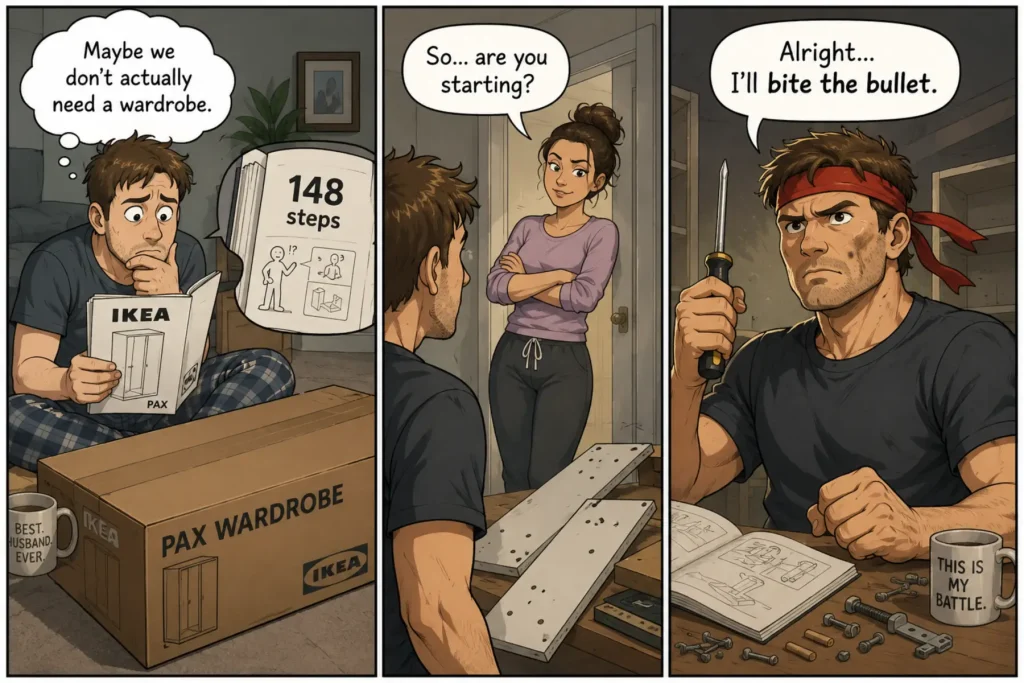
The IKEA Battle: Bite the Bullet
Bite the Bullet Conversation: Facing an Uncomfortable Talk
Two friends are talking after work. One of them has been avoiding an uncomfortable conversation with her manager.
- A: I still haven’t told Mark I can’t take on the extra project.
- B: Are you worried he’ll be annoyed?
- A: Yeah. I know he needs the help, but I just don’t have the time.
- B: Then you’re probably just going to have to bite the bullet and tell him today.
- A: I know, I know. I’ve been putting it off all week.
- B: It’ll only feel worse if you wait until Friday.
- A: You’re right. I’ll go talk to him right after lunch.
- B: Good luck! Just be honest and keep it professional.
Want more real English like this?
I share practical phrasal verbs, idioms, natural expressions, common mistakes, and short English quizzes on Telegram — in the same clear, everyday style.
Bite the Bullet Correctly: Avoid These Common Mistakes
Mistake 1
- ❌ Wrong: I bited the bullet and called him.
- Correct: I bit the bullet and called him.
- 👉 Why: Bite is an irregular verb. The past tense form is always bit, never bited. This is the absolute foundation of bite the bullet grammar.
Mistake 2
- ❌ Wrong: I bit bullet and paid the bill.
- Correct: I bit the bullet and paid the bill.
- 👉 Why: This is a fixed idiomatic expression. You cannot drop the definite article — it must always remain the bullet.
Mistake 3
- ❌ Wrong: I bit the bullet to my teacher.
- Correct: I bit the bullet and talked to my teacher.
- 👉 Why: You cannot “bite the bullet to someone.” The idiom must always be followed by the and + action pattern.
Mistake 4
- ❌ Wrong: I bit the bullet and ate my favorite chocolate cake.
- Correct: I treated myself to my favorite chocolate cake.
- 👉 Why: This phrase is reserved strictly for unpleasant or forced actions. If the activity is enjoyable or fun, choose an entirely different expression.
Mistake 5
- ❌ Wrong: She has bitten the bullet yesterday.
- Correct: She bit the bullet yesterday.
- 👉 Why: When you use specific, finished time markers (like yesterday, last week, or in 2024), you must use the Past Simple (bit), not the Present Perfect (has bitten).
Don’t Confuse “Bite the Bullet” with These Expressions
“Bite the Bullet” vs. “Bite the Dust”
- Why learners confuse them: Both phrases start with the word bite.
- The Difference: Bite the bullet means to face a tough situation. Bite the dust means to fail, break, or die.
- 👉 Example: “My old laptop finally bit the dust (broke), so I had to bite the bullet and spend my savings on a new one (forced, unpleasant decision).”
“Bite the Bullet” vs. “Pull the Trigger”
- Why learners confuse them: Both are action idioms used when someone finally makes a big decision after a long delay.
- The Difference: Pull the trigger simply means to make a final move, buy something, or launch a project. It is usually an exciting or positive decision. Bite the bullet is strictly for unpleasant or painful choices.
- 👉 Example: “After months of research, we finally pulled the trigger and booked our dream tickets to Paris!”
Expanded Vocabulary: “Bite the Bullet” Synonyms and Alternatives
“Face the Music” (Focus: Responsibility)
- What it means: To accept the unpleasant consequences of your actions, especially after making a mistake or lying.
- The Difference: Bite the bullet is about doing a tough but necessary task. Face the music is strictly about accepting punishment or criticism for something you did wrong.
- 👉 Example: “He lied to the client about the delay, and now he has to face the music.”
“Get It Over With” (Focus: Speed)
- What it means: To do an unpleasant task quickly so that you don’t have to think about it anymore.
- The Difference: This is a highly popular, casual everyday phrase. It focuses purely on ending the stressful waiting, whereas bite the bullet sounds a bit more serious and dramatic.
- 👉 Example: “I hate talking to the bank, but let’s just get it over with and call them now.”
“Take the Plunge” (Focus: Risk)
- What it means: To finally make a major, important, or risky decision after thinking about it for a long time.
- The Difference: Taking the plunge can be incredibly positive, exciting, and life-changing (like getting married or starting a business). Biting the bullet almost always feels forced and unpleasant.
- 👉 Example: “After years of dreaming about it, they finally took the plunge and opened their own cozy café.”
The Flip Side: Useful Contrast Expressions
“Put It Off” (The Opposite Action: Delaying)
- What it means: To intentionally delay doing something until a later time or date; to procrastinate.
- The Contrast: Instead of facing the painful situation right now, you actively run away from it and choose to wait.
- 👉 Example: “I kept putting it off for weeks, but eventually, I had to bite the bullet and call the technician.”
“Chicken Out” (The Opposite Result: Losing Courage)
- What it means: To decide not to do something at the very last second because you are too afraid, nervous, or anxious.
- The Contrast: While biting the bullet shows that you found the courage to face your fear, chickening out means your fear won and you backed down.
- 👉 Example: “He completely planned to bite the bullet and apologize to her, but he chickened out at the last minute.”
1.Which option fits best?
I hate making phone calls, but I need to speak to the doctor. I should probably ______ tomorrow.
a) bite the dust
b) bite the bullet
c) bite a bullet
2.Fill in the blank with the correct form of the idiom:
After ignoring the plumbing problem for months, we finally ______ and replaced the old kitchen pipe.
3.Spot and fix the grammatical error in this sentence:
“I bited the bullet and sent the resignation email.”
4.Which of these sentences uses the expression correctly?
a) I bit the bullet and ate that delicious piece of cake.
b) I bit the bullet and apologized to my colleague after our argument.
c) I bit the bullet and truly enjoyed the weekend party.
5.Rewrite this sentence using the idiom:
“She finally accepted that she had to pay for the expensive car repair.”
6.Would a native speaker say this? (Yes/No and why):
“He bit the bullet and booked his dream holiday to Hawaii.”
7.Your friend is terrified of telling the truth to her boss. Which advice sounds most natural?
a) Just bite the bullet and tell him.
b) Bite the dust and tell him.
c) Bite the bullet to him.
Answer key:
- b) bite the bullet (Option ‘a’ means to break/die; option ‘c’ uses the wrong article).
- bit the bullet (We use the past simple form “bit” because the action happened in the past).
- “I bit the bullet and sent the resignation email.” (The past tense of bite is irregular – bit, never bited).
- b) (Apologizing is tough and uncomfortable. Eating cake and enjoying parties are positive experiences, so the idiom cannot be used there).
- “She finally bit the bullet and paid for the expensive car repair.”
- No. (Booking a dream vacation is an exciting, happy event. The idiom only applies to forced, unpleasant, or stressful actions).
- a) Just bite the bullet and tell him. (Option ‘b’ is incorrect in meaning; option ‘c’ breaks the grammar rule – you cannot “bite the bullet to” someone).