Call It a Day Meaning: The Natural Way to Stop for Today
To “call it a day” means to stop working or doing an activity for the rest of the day. People usually use this expression when they are tired or feel they have done enough work.

- So, What Does “Call It a Day” Really Mean?
- When to Use "Call It a Day" Naturally
- “Call It a Day” or “Call It a Night”?
- Common Phrases with “Call It a Day”
- Call It a Day Meaning: See It in Action With Our Mini Comic
- Using "Call It a Day" in a Dialogue
- 5 Common Mistakes to Avoid with "Call It a Day"
- 3 Natural Alternatives to "Call It a Day" And When to Use Them
- 2 Useful Contrast Expressions
- Practice
- 2.Which phrase sounds more natural?
- Quick recap
So, What Does “Call It a Day” Really Mean?
Picture two colleagues still staring at the same presentation after four hours. The slides are not getting better anymore, and everyone is tired. One of them says:
“Let’s call it a day.”
Nobody is talking about the calendar. They simply mean that it’s time to stop working for now.
The call it a day expression means to wrap up an activity because you’ve done enough, you’re tired, or continuing isn’t useful anymore. Most of the time, it doesn’t mean giving up forever – it just means finishing for today and coming back to it later.
This idiom often appears as a complete suggestion:
Let’s call it a day.
Or as a personal decision:
I think I’ll call it a day.
I’m calling it a day because I can’t concentrate anymore.
The literal words can easily confuse learners. You are not “calling” a real day on the phone. Think of it as announcing that today’s work is officially done.
When to Use “Call It a Day” Naturally
Native speakers usually say it after spending a significant amount of time on an activity. It usually follows a specific trigger: people get tired, finish a major part of a task, notice that progress has slowed down, or realize it’s getting late.
For example, imagine two friends studying for an exam. After several hours, they begin making silly mistakes instead of actually learning. One friend laughs and says:
“I think we should call it a day and start again tomorrow.”
You will hear it in simple everyday situations like these:
- Finishing work
- Cleaning the house
- Wrapping up a long drive
- Studying for hours
- Trying to solve a difficult problem
- Finishing a workout
Notice that native speakers often pair the idiom with another action:
- call it a day and go home
- call it a day and continue tomorrow
- call it a day and get some rest
“Call It a Day” or “Call It a Night”?
These phrases are close, but they are not the same.
Use call it a day when you stop working, studying, or doing a daytime activity.
“We’ve finished the main tasks, so let’s call it a day.”
Use call it a night when you leave a party, end an evening with friends, or go to bed.
“It’s getting late. I think I’ll call it a night.”
So the difference is simple: call it a day usually belongs to work or daytime activities. Call it a night belongs to the end of the evening.
Common Phrases with “Call It a Day”
|
Phrase |
How it sounds in real life |
|
Let’s call it a day. |
You say this when the whole group has done enough for today. Example: “We’ve made good progress. Let’s call it a day.” |
|
I think I’ll call it a day. |
You are deciding to stop because you are tired, finished, or not getting much done anymore. Example: “I’m getting tired. I think I’ll call it a day and finish this tomorrow.” |
|
I’m calling it a day. |
You are telling someone that you are done for now, often as you leave or close your laptop. Example: “My inbox is finally empty, so I’m calling it a day.” |
|
Time to call it a day. |
This works when it is already clear that the work should stop. It sounds softer than just saying “Stop.” Example: “It’s almost nine. Time to call it a day.” |
|
We should probably call it a day. |
This is a gentle way to suggest stopping, especially if the group is tired or stuck. Example: “We’re running out of ideas. We should probably call it a day.” |
|
Let’s call it a day and continue tomorrow. |
This makes it clear that you are stopping now, not giving up completely. Example: “Let’s call it a day and continue tomorrow with fresh eyes.” |
Call It a Day Meaning: See It in Action With Our Mini Comic
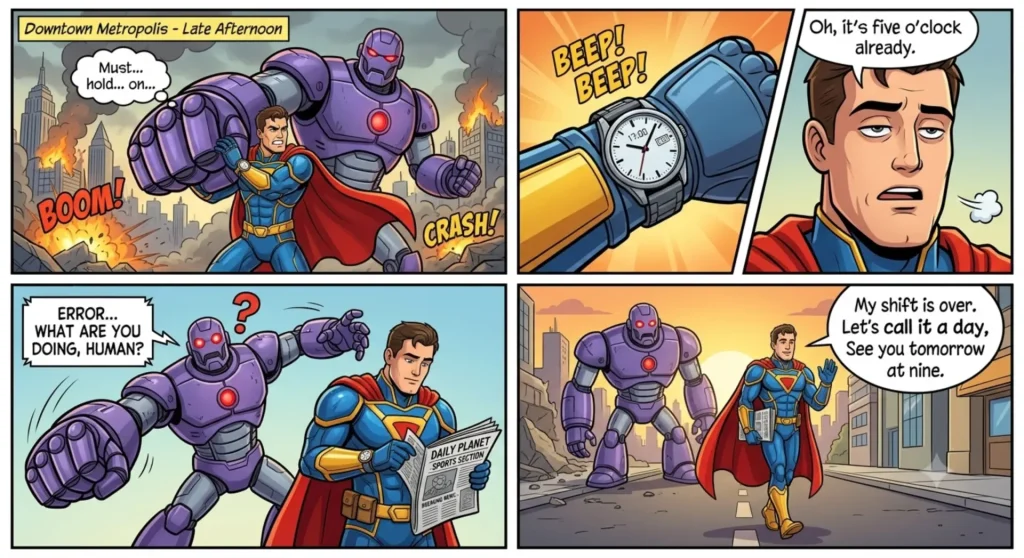
Using “Call It a Day” in a Dialogue
Anna and Ben have been working on the same presentation all afternoon. At this point, they are tired, and the edits are not really improving anything.
Anna: We’ve been working on these slides for almost five hours.
Ben: I know. I’m starting to make obvious mistakes.
Anna: We’ve fixed the most important parts already.
Ben: Yeah. Time to call it a day?
Anna: I think so. Let’s call it a day and look at it again tomorrow morning.
Ben: Good idea. Fresh eyes always help.
Want more real English like this?
I share practical phrasal verbs, idioms, natural expressions, common mistakes, and short English quizzes on Telegram — in the same clear, everyday style.
5 Common Mistakes to Avoid with “Call It a Day”
Mistake 1: Forgetting the article
- Wrong: Let’s call it day.
- Correct: Let’s call it a day.
- Why: The article “a” is a mandatory part of this fixed expression.
Mistake 2: Using the wrong tense for sudden decisions
- Wrong: I call it a day now.
- Correct: I’ll call it a day now. / I’m calling it a day now.
- Why: In this situation, English speakers usually say “I’ll call it a day” or “I’m calling it a day,” not “I call it a day.”
Mistake 3: Using the wrong article
- Wrong: Let’s call it the day.
- Correct: Let’s call it a day.
- Why: This idiom never uses the definite article “the.”
Mistake 4: Confusing it with quitting permanently
- Wrong: I called it a day because I quit my job forever.
- Correct: I quit my job.
- Why: “Call it a day” means stopping an activity for now. It does not mean leaving a job or stopping something permanently.
3 Natural Alternatives to “Call It a Day” And When to Use Them
Wrap it up
- Meaning: To finish the final part of what you are currently doing.
- The Difference: Focuses on actively completing a specific task right now, rather than just stopping because the workday is over.
- Example: “Let’s wrap it up before the manager arrives.”
Finish up
- Meaning: To complete the very last details of a project or action.
- The Difference: This is more direct, literal, and less idiomatic than call it a day.
- Example: “I’ll finish up this email and then head home.”
Stop for today
- Meaning: To end today’s work or activity.
- The Difference: A simple, neutral phrase. It works well when you want to be clear rather than idiomatic.
- Example: “Let’s stop for today and continue tomorrow morning.”
2 Useful Contrast Expressions
Keep going
- Meaning: To continue doing an activity without stopping.
- The Difference: Instead of wrapping things up, you choose to continue.
- Example: “We’re exhausted, but let’s keep going for another thirty minutes.”
Carry on
- Meaning: To continue with an activity or a plan.
- The Difference: This phrase is very common, especially in British English, and sounds natural in everyday speech.
- Example: “The weather changed, but they carried on with the hike.”
1.Choose the best option:
We’ve been working for six hours straight. Let’s ______.
- a) call it a day
b) call the day
c) call a day
2.Which phrase sounds more natural?
- a) I call it a day now.
b) I’ll call it a day now.
3.Is this idiom used correctly here?
Your manager says after a productive meeting:
“Let’s call it a day and continue tomorrow.”
Yes or No?
Answer key:
- a
- b – We usually use “I’ll” or “I’m” for decisions made at the moment of speaking.
- Yes – It’s polite, friendly, and completely normal among colleagues.