Let the Cat Out of the Bag Meaning: Everyday Usage Guide
The let the cat out of the bag meaning is simple: it means to reveal a secret, usually by accident. For instance, if you are planning a surprise birthday party and someone accidentally mentions it to the guest of honour, they have just let the cat out of the bag.

- What Does Let the Cat Out of the Bag Mean?
- When Should You Use "Let the Cat Out of the Bag"?
- Is This Idiom Formal or Informal?
- Examples of "Let the Cat Out of the Bag" in a Sentence
- Common Phrases with "Let the Cat Out of the Bag"
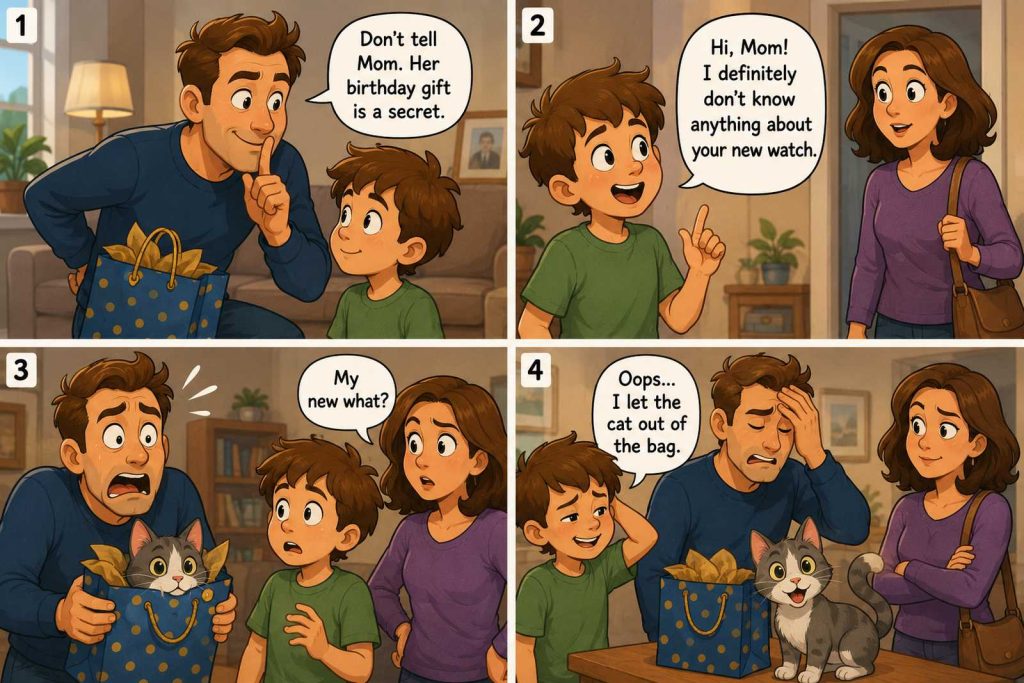
- Mini Comic: Let the Cat Out of the Bag
- See It in Action: How a Real Conversation Flows
- Easy to Mess Up: Typical Learner Mistakes
- Close, But Not the Same: Idioms You Might Mix Up
- Switch It Up: Other Ways to Say It
- Keep It Quiet: How to Say the Opposite
- Check Your Progress: Practice Exercises
- Quick recap
What Does Let the Cat Out of the Bag Mean?
Imagine this situation. Your family has spent weeks planning a surprise birthday party. Everyone knows about it except your sister. At dinner, your little brother suddenly says, “I can’t wait for your party on Saturday!”
Everyone looks at him. The surprise is gone. He let the cat out of the bag.
The meaning of this idiom is simple: someone reveals a secret before they are supposed to. Most of the time it happens by accident, usually because someone speaks too soon, posts something online, or gives away a small detail.
The literal picture — a cat coming out of a bag — is unusual, but you do not need to think about a real cat. Native speakers understand it as a fixed expression about a secret becoming public. It is incredibly common when talking about confidential information, work promotions, pregnancy announcements, or family news.
If the secret can no longer be hidden, you might also hear shorter variations like “The cat is out” or, more commonly, “The cat is out of the bag.”
In casual speech and informal writing, you will often encounter shortened or modified forms of the expression. For instance, people frequently drop articles or use possessives, resulting in phrases like cats out the bag, or simply reducing it to cat out bag. Even grammatically looser variants such as cat let out of the bag are widely understood in everyday English, though the full standard idiom remains the benchmark.
One final thing: this expression is only used when information is supposed to be kept private. If everyone already knows the news, you cannot let the cat out of the bag.
When Should You Use “Let the Cat Out of the Bag”?
Knowing the meaning is only the first step; the real challenge is how to use “let the cat out of the bag” naturally. Native speakers usually choose this idiom when there is a clear plan to keep something secret until the right moment.
Imagine your manager wants to announce a new team leader during Friday’s meeting. On Wednesday, an employee accidentally congratulates the new leader in front of the whole office. Someone might smile and say: “Well… you just let the cat out of the bag.” Nobody is angry, but the speaker is pointing out that the surprise has disappeared.
Here are other everyday situations where the idiom sounds perfectly natural:
- A friend accidentally reveals an upcoming engagement.
- A child mentions hidden Christmas presents too early.
- Someone shares private travel plans in a busy group chat.
- A coworker talks about a product launch before the official announcement.
Remember one simple rule: use it when a secret becomes public before people expected it to. It often serves as a friendly warning, such as: “Don’t let the cat out of the bag,” which simply means: “Please don’t tell anyone yet.”
It is easy to make mistakes with its structure. For instance, writing don t let cat out of the bag without the apostrophe or dropping the article changes the rhythm of the sentence. Similarly, phrases like let the cat out of the box or let the cat of the bag are common errors that native speakers never use. To keep your English natural, stick strictly to the standard form: let the cat out of the bag.
Is This Idiom Formal or Informal?
It is incredibly common in text messages, family discussions, casual workplace chats with colleagues, as well as in podcasts and interviews. However, it is much less common in formal reports, legal writing, or academic essays, where writers usually choose precise words like reveal, disclose, or make public instead.
Another important point is tone. If you laugh while saying, “You let the cat out of the bag!”, it sounds playful. But if you say exactly the same sentence with an annoyed voice, it becomes a gentle criticism. The idiom itself is never rude; your intonation decides whether it sounds funny, disappointed, or slightly blaming, which is exactly why it appears so frequently in natural English conversation.
Examples of “Let the Cat Out of the Bag” in a Sentence
- I almost let the cat out of the bag when I mentioned the surprise trip at dinner.
- She let the cat out of the bag about the engagement before anyone was ready to announce it.
- We worked for months on the project, but one social media post let the cat out of the bag.
- Please don’t let the cat out of the bag until everyone arrives.
- “Who let the cat out of the bag?” the teacher asked after everyone suddenly knew about the school event.
- Someone texted the news to the whole group. Now the cat is out, and there is no point pretending it is still a secret.
Common Phrases with “Let the Cat Out of the Bag”
|
Common Phrase |
Context & Meaning |
|
Let the cat out of the bag |
To reveal a secret accidentally |
|
Don’t let the cat out of the bag |
A request to keep a secret or surprise |
|
Who let the cat out of the bag? |
A question asked when a secret is exposed |
|
The cat is out of the bag |
Used when the secret is already public knowledge |
|
Almost let the cat out of the bag |
When someone nearly ruins a surprise |
|
Accidentally let the cat out of the bag |
Emphasises that the leak was completely unintentional |
Mini Comic: Let the Cat Out of the Bag
See It in Action: How a Real Conversation Flows
Emma and Jake are planning a surprise dinner for their parents. Everything is ready until Emma says something she shouldn’t.
- Emma: I think I’ve just let the cat out of the bag.
- Jake: Oh no, what happened?
- Emma: Dad asked why I was buying balloons, and I told him they were for Saturday.
- Jake: Did he guess?
- Emma: He smiled and asked if we were planning a party.
- Jake: Well… the cat is out of the bag now!
- Emma: I guess we’ll just have to surprise him with something else instead.
Want more real English like this?
I share practical phrasal verbs, idioms, natural expressions, common mistakes, and short English quizzes on Telegram — in the same clear, everyday style.
Easy to Mess Up: Typical Learner Mistakes
Mistake 1: Dropping Articles
- Wrong: He let cat out of bag.
- Correct: He let the cat out of the bag.
- Why: This is a fixed expression. Both definite articles are mandatory.
Mistake 2: Wrong Prepositions
- Wrong: She let the cat out from the bag.
- Correct: She let the cat out of the bag.
- Why: The idiom strictly requires “out of”, never “out from”.
Mistake 3: Misunderstanding the Context
- Wrong: He let the cat out of the bag about the weather.
- Correct: He let the cat out of the bag about the surprise party.
- Why: The phrase only applies to information that is supposed to stay secret.
Mistake 4: Using It in Formal Writing
- Wrong: The manager let the cat out of the bag (in a formal financial report).
- Correct: The manager disclosed the information.
- Why: In business or academic writing, professional verbs like disclose, reveal, or announce are always more appropriate.
Mistake 5: Pluralising the Noun
- Wrong: The cats are out of the bag.
- Correct: The cat is out of the bag.
- Why: The idiom is fundamentally singular; changing it to the plural form sounds completely unnatural to native speakers.
Close, But Not the Same: Idioms You Might Mix Up
- The Difference: Both idioms mean revealing secret information. However, spill the beans often sounds a little more playful and focuses on the act of telling. Let the cat out of the bag specifically highlights the exact moment a surprise or major plan is accidentally spoiled.
- Example: Don’t spill the beans about the wedding!
Blurt out
- The Difference: Both expressions describe saying something without thinking. The key difference is that blurt out focuses purely on speaking suddenly and impulsively. The information you share does not even have to be a secret.
- Example: He blurted out the answer before anyone else could speak.
Switch It Up: Other Ways to Say It
Let slip
- The Nuance: A softer, subtler alternative. It is perfect for situations where someone doesn’t reveal the whole story, but accidentally drops a small detail or a single piece of private information.
- Example: She let slip that they were moving abroad.
Give away a secret
- The Nuance: This is a neutral phrasal verb rather than a colourful idiom. Because it is stylistically flexible, it works seamlessly in both spoken English and formal written contexts where idioms might sound too casual.
- Example: His smile gave away the secret before he said a word.
Keep It Quiet: How to Say the Opposite
Keep a secret
- The Nuance: This is the most direct, everyday phrase. Instead of accidentally revealing private information, you actively protect it.
- Example: Can you keep a secret until Friday?
Keep it under wraps
- The Nuance: A great conversational idiom that means to keep something strictly hidden until the right time. It is especially common in business when talking about new projects, product launches, or official announcements.
- Example: The company kept the new product under wraps for months.
Check Your Progress: Practice Exercises
1.We spent three weeks planning a secret dinner for Mum, but my little brother completely spoiled the surprise. He ______.
a) kept it under wraps
b) let the cat out of the bag
c) blurted out the weather
2.Your colleague accidentally tells the entire office about your upcoming promotion before the manager can make the official announcement. Which expression fits best?
a) She let the cat out of the bag.
b) She spilled the beans.
Hint: Think about whether this is a ruined official plan/surprise or just a playful gossip session.
3.Spot and correct the grammatical errors in this sentence:
“She was so excited that she accidentally let cat out from bag.”
4.Read the sentence below. Is the use of the idiom natural or unnatural? Why?
“We already announced our moving plans to everyone on Facebook yesterday, so today John let the cat out of the bag.”
Answer key:
- b) let the cat out of the bag. (The context explicitly mentions a spoiled surprise party, which is the perfect scenario for this idiom).
- a) She let the cat out of the bag. (While both mean revealing secrets, let the cat out of the bag is the better fit here because it highlights a ruined official announcement or a specific planned surprise).
- Corrected: “She was so excited that she accidentally let the cat out of the bag.” (Remember, this is a fixed expression; you cannot drop the definite articles or replace “out of” with “out from”).
- Unnatural. (The idiom only applies when information is supposed to stay private. Since the news was already made public on Facebook yesterday, there is no secret left to hide today).