Cut Corners Meaning: When “Fast and Cheap” Becomes a Problem
Cut corners meaning: to do something faster, cheaper, or more easily by skipping important steps, often at the cost of quality, safety, or proper standards.
- When a Shortcut Goes Too Far
- Why People Cut Corners Under Pressure
- The Tone Behind “Cut Corners”: Useful, but Not Soft
- Cut Corners Idiom Meaning and Examples That Don’t Sound Forced
- Cut Corners Meaning in One Funny Burger Story
- Phrases You’ll Actually Hear with “Cut Corners”
- A Dialogue Where the Idiom Belongs
- Small Grammar Details That Make a Big Difference
- Mistakes That Make “Cut Corners” Sound Wrong
- Don’t Mix It Up with Nearby Phrases
- Better Alternatives When “Cut Corners” Isn’t Quite Right
- Practice Time!
- Quick recap
When a Shortcut Goes Too Far
The report is due at 9 a.m. The team is tired. Someone removes the final fact-checking stage because “there’s no time.” The report goes out faster, but the numbers are wrong.
That is cutting corners.
The idiom cut corners means doing something in a quicker, cheaper, or easier way by leaving out steps that should stay in place. The result may look fine for a moment, but quality, safety, accuracy, or trust often suffers later.
The cut corners meaning is not “work efficiently.” Efficient work improves the process. Cutting corners weakens it.
- Efficient: We used a better system and checked the data faster.
- Cutting corners: We stopped checking the data.
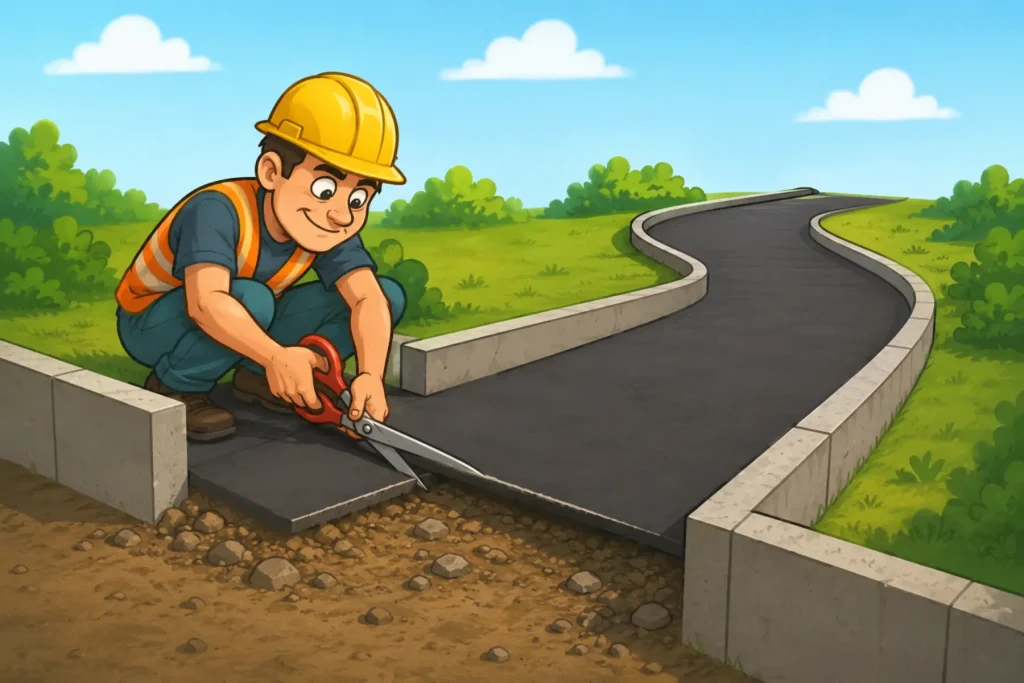
The literal image is a person taking a shorter route instead of going properly around a corner. In real English, the idiom is usually figurative: it is about skipped steps and lower standards, not about streets or driving.
Why People Cut Corners Under Pressure
People usually cut corners when something feels limited: time, money, staff, patience, or energy.
At work, a manager may rush a project to please a client. At school, a student may read summaries instead of doing the full assignment. At home, a cheap repair may look fine until the same problem comes back two weeks later.
The idiom works especially well when there is a trade-off:
They cut corners to save money.
She cut corners to finish the work faster.
We can’t cut corners on safety.
The phrase is useful in business English because it points to a real risk: a decision that saves money now can create bigger costs later.
The Tone Behind “Cut Corners”: Useful, but Not Soft
Cut corners is common, natural English. It works in conversation, emails, meetings, online reviews, and news stories. It is not slang, but it is not especially formal either.
The tone is usually critical.
- They cut corners on safety.
This does not sound neutral. It suggests someone acted irresponsibly.
The idiom can sound sharp when aimed directly at a person:
- You cut corners on this presentation.
That may be true, but it sounds like an accusation. In polite feedback, a softer version often works better:
- Some parts of the presentation feel rushed.
- A few details need another check.
Use cut corners when the criticism is clear and the situation really involves lowered standards, skipped steps, or unnecessary risk.
Cut Corners Idiom Meaning and Examples That Don’t Sound Forced
- The company cut corners on safety to reduce costs.
- Don’t cut corners just because you’re in a hurry.
- Some students cut corners by reading summaries instead of the full text.
- The restaurant refuses to cut corners on ingredients.
- They cut corners to finish the renovation before opening day.
- If we cut corners now, we’ll probably spend next week fixing mistakes.
- The online reviews said the manufacturer had cut corners on quality.
- You can’t cut corners with medical testing.
- The team cut corners on training, and the new employees felt unprepared.
A useful cut corners idiom sentence in a work context:
The project looked successful at first, but later we realized corners had been cut during testing.
The passive form corners had been cut sounds a little more formal. It is useful when the problem matters more than naming the person responsible.
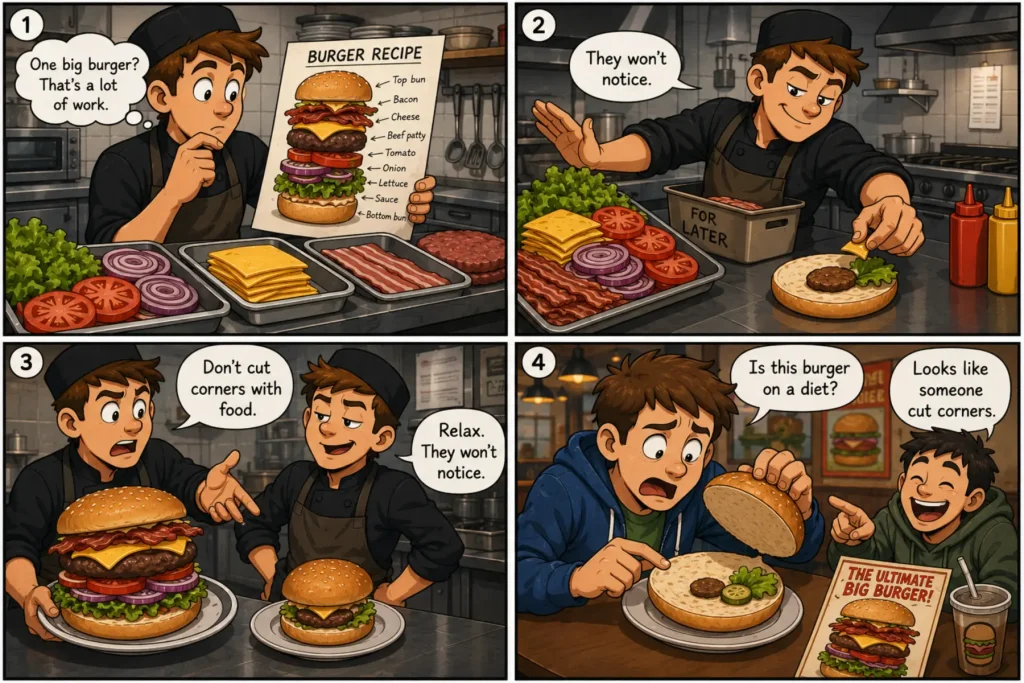
Cut Corners Meaning in One Funny Burger Story
Phrases You’ll Actually Hear with “Cut Corners”
|
Common phrase |
Natural context |
|
cut corners on safety |
construction, transport, healthcare, public services |
|
cut corners on quality |
products, reports, materials, customer service |
|
cut corners to save money |
business decisions, budgeting, cheap solutions |
|
cut corners to save time |
deadlines, schoolwork, rushed projects |
|
don’t cut corners |
advice, warnings, instructions |
|
corners were cut |
complaints, reports, investigations |
Be careful with to cut a corner or cut the corner. In literal English, these can describe movement, especially on a road. For the idiom about poor standards, the normal form is cut corners, without a or the.
A Dialogue Where the Idiom Belongs
Two colleagues are talking after a rushed product launch.
Maya: The client found three major bugs this morning.
Leo: I saw the message. We should have tested the payment page again.
Maya: We didn’t have time. The launch date was fixed.
Leo: I know, but we cut corners, and now it’s costing us more.
Maya: Next time, testing stays in the schedule.
Leo: Agreed. A fast launch isn’t worth it if the product doesn’t work.
Want more real English like this?
I share practical phrasal verbs, idioms, natural expressions, common mistakes, and short English quizzes on Telegram — in the same clear, everyday style.
Small Grammar Details That Make a Big Difference
The idiom is fixed as cut corners.
The verb changes normally:
- Present: Companies sometimes cut corners when budgets are tight.
- Third person singular: He cuts corners when he is in a hurry.
- Past: They cut corners during the renovation.
- Continuous: You’re cutting corners again.
- Perfect: The team has cut corners to meet the deadline.
The verb cut has the same form in the base form, past simple, and past participle:
They cut corners yesterday.
They have cut corners before.
The most common grammar patterns are:
cut corners on + noun
Don’t cut corners on testing.
They cut corners on staff training.
cut corners with + noun
You can’t cut corners with legal documents.
The company cut corners with the design process.
cut corners to + verb
He cut corners to finish faster.
They cut corners to keep the price low.
Mistakes That Make “Cut Corners” Sound Wrong
Mistake 1: Adding “the”
- Wrong: They cut the corners to save money.
- Correct: They cut corners to save money.
- Why: The idiom is cut corners, without the.
Mistake 2: Making it too positive
- Wrong: Our team cut corners and became more productive.
- Correct: Our team found a more efficient process and became more productive.
- Why: Cutting corners meaning includes a negative trade-off.
Mistake 3: Using the wrong preposition
- Wrong: They cut corners in safety.
- Correct: They cut corners on safety.
- Why: The natural pattern is cut corners on + noun.
Don’t Mix It Up with Nearby Phrases
Take shortcuts
- Both phrases describe a faster or easier way to do something.
- Difference: Take shortcuts can be neutral or negative; cut corners is more clearly critical.
- Example: There are no shortcuts when you are learning pronunciation properly.
Cut costs
- Both can involve saving money.
- Difference: Cut costs means reduce spending; cut corners means reduce effort, quality, safety, or standards.
- Example: The company cut costs by using less office space, not by lowering product quality.
Better Alternatives When “Cut Corners” Isn’t Quite Right
Skimp on
- Meaning: To use too little money, time, or effort for something important.
- Difference: Skimp on focuses on not giving enough resources.
- Example: Don’t skimp on safety equipment.
Compromise quality
- Meaning: To make quality worse because of another priority.
- Difference: This is more formal and more direct than cut corners.
- Example: We need to reduce the budget without compromising quality.
Take the easy way out
- Meaning: To choose the easiest option instead of the better or more responsible one.
- Difference: This phrase often sounds more moral or emotional.
- Example: Copying the answer would be taking the easy way out.
Practice Time!
Task 1: Context & Nuance
Read the scenarios below. In which of the following situations is it inappropriate to use the phrase “cut corners”?
- Scenario A: A software company is in a rush, so they skip the final testing phase and release the app with known bugs just to meet the deadline.
- Scenario B: A construction firm uses cheaper, untested materials to finish a bridge ahead of schedule, risking structural integrity.
- Scenario C: An accountant finds a legitimate tax loophole that reduces the company’s expenses by 15% without breaking any laws.
Task 2: Collocations & Grammar Error Correction
Find and correct the mistakes in the sentences below. Some sentences contain grammatical errors, while others use incorrect prepositions.
- We cannot afford to cut the corners when it comes to cybersecurity.
- The project was late, so they decided to cut corners in the testing phase.
- Don’t cut corners with quality just to meet the deadline.
Task 3: Matching Definitions
Match the formal or descriptive phrases from the article with their correct meanings.
- Compromise quality
- Skimp on
- Take the easy way out
- A) To choose the easiest option instead of the better or more responsible one (often sounds moral or emotional).
- B) To use too little money, time, or effort for something important.
- C) To make quality worse because of another priority (more formal and direct than “cut corners”).
Task 4: Complete the Sentences
Fill in the blanks using the correct phrase: skimp on, compromise quality, or take the easy way out. Change the verb form if necessary.
- Copying the answer from the internet would be ____________________ instead of studying for the exam.
- We need to reduce the factory budget, but we must do it without ____________________.
- Don’t ____________________ safety equipment; buy the best helmets available for the workers.
Answer key:
- Task 1: Scenario C. “Cutting corners” always implies a negative undertone of skipping essential steps or lowering quality. In Scenario C, the accountant is legally reducing expenses, which is called “cutting costs.”
- Task 2, Sentence 1: We cannot afford to cut corners when it comes to cybersecurity. (The idiom never takes an article).
- Task 2, Sentence 2: The project was late, so they decided to cut corners on (or during) the testing phase.
- Task 2, Sentence 3: Don’t cut corners on quality just to meet the deadline.
- Task 3, Phrase 1: C (Compromise quality means to make quality worse because of another priority).
- Task 3, Phrase 2: B (Skimp on focuses on not giving enough resources like money, time, or effort).
- Task 3, Phrase 3: A (Take the easy way out means choosing the easiest path instead of the responsible one).
- Task 4, Sentence 1: taking the easy way out (Because copying is the easiest, less responsible option).
- Task 4, Sentence 2: compromising quality (Because it talks about making a product worse due to a budget priority).
- Task 4, Sentence 3: skimp on (Because it talks about not spending enough money or resources on important equipment).