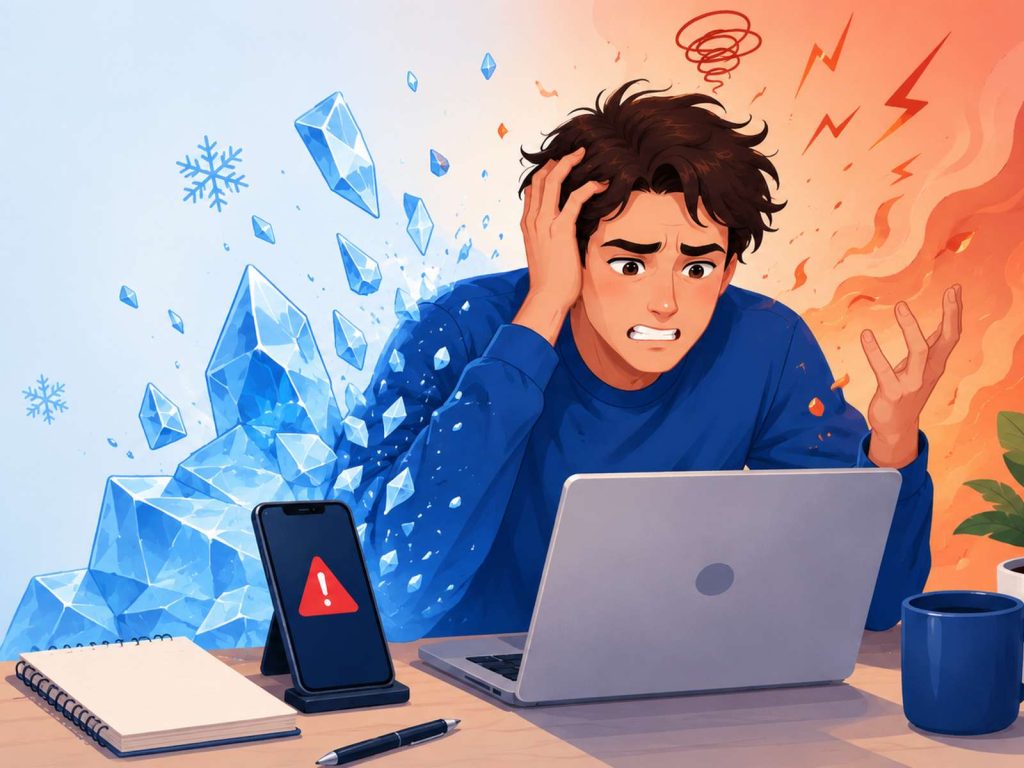
Unlock the Real Break the Ice Meaning (And Stop the Awkward Silence!)
At its core, the break the ice idiom meaning is all about making people feel relaxed and comfortable when meeting for the first time, instantly melting away that uncomfortable, heavy silence.

- How to Master the To Break the Ice Idiom Meaning in English Easily
- Real-Life Guide: How to Use Break the Ice in a Sentence
- Quick examples:
- Real-Life Examples: How to Use Break the Ice in a Sentence
- Smart Cheat Sheet: Idiom of Break the Ice Sentence Patterns
- How to Break the Ice: A Literal Guide to Modern Dating 🧊🔨
- Dialogue: Idiom of Break the Ice in Action
- Common Mistakes to Avoid
- Don't Confuse It With…
- Similar Expressions You Can Use
- Opposite and Contrast Expressions
- Practice Time!
- Quick recap
How to Master the To Break the Ice Idiom Meaning in English Easily
Imagine you’re at your first day in a new office. Everyone is polite, but nobody is talking much. Then one colleague smiles and says, “So… who else can’t function without coffee?” People laugh, start chatting, and suddenly the room feels much warmer.
That’s exactly what using the idiom of break the ice looks like in real life.
Essentially, it means saying or doing something to ease the tension when people first meet. Fun fact: it originally comes from actual ships clearing a path through frozen waters. In a conversation, that “ice” is just the awkward silence – and once you break it, the words start flowing naturally.
Just keep in mind: It doesn’t just mean “start talking.” You can start a conversation and still feel miles apart. This idiom specifically implies that there was some initial awkwardness to overcome before everyone finally relaxed.
Real-Life Guide: How to Use Break the Ice in a Sentence
Native speakers use this phrase whenever things feel a bit stiff and need a friendly push.
Imagine arriving at a birthday party where you only know one person. Everyone else is chatting in small groups. Instead of letting you stand there quietly, a guest introduces themselves and asks where you’re from. That simple question instantly helps everyone relax. Later, you might say: “That really helped break the ice.”
At work, the expression is just as common. A manager might kick off a meeting with a light, funny question instead of jumping straight into stressful deadlines. A teacher might ask students to chat in pairs before starting a tough lesson, and a tour guide could share a quick joke before explaining the day’s schedule. These small gestures are all designed to remove that initial tension.
In everyday English, you’ll often hear it paired with verbs like help, try, need, or want. It also naturally links to specific settings using simple prepositions like at, with, or before:
- …with new people
- …at a meeting
- …before the discussion
- …during introductions
Quick examples:
- A quick game helped break the ice.
- She tried to break the ice with a friendly question.
- We needed something to break the ice before the presentation.
You will also see this happen online all the time. Someone joining a new group chat might post a quick introduction or a funny GIF to start chatting comfortably before diving into serious discussions.
Real-Life Examples: How to Use Break the Ice in a Sentence
- The manager started the meeting with a funny question to break the ice before discussing the project.
- On the first day of class, our teacher asked everyone to share an interesting fact to break the ice.
- I didn’t know anyone there, but one guest came over and talked about travel. It really broke the ice.
- We brought some homemade cookies to break the ice after moving into the building.
- She introduced herself in the group chat to break the ice before asking for help.
- My cousin made a light joke that helped break the ice between the two families.
- His serious speech didn’t break the ice – everyone still looked uncomfortable.
- How do you usually break the ice when you meet new people?
- The professor used a short game to break the ice before dividing students into groups.
- While waiting for the train, I asked another traveler where they were from. It was an easy way to break the ice.
Smart Cheat Sheet: Idiom of Break the Ice Sentence Patterns
|
Verb Pattern |
Example |
|
Verb + break the ice |
A quick game helped break the ice. |
|
Try to + break the ice |
She tried to break the ice with a friendly question. |
|
Need + break the ice |
We needed something to break the ice before the presentation. |
|
Past Simple (broke) |
One guest came over and talked about travel. It really broke the ice. |
|
Negative form (didn’t) |
His serious speech didn’t break the ice – everyone still looked uncomfortable. |
How to Break the Ice: A Literal Guide to Modern Dating 🧊🔨
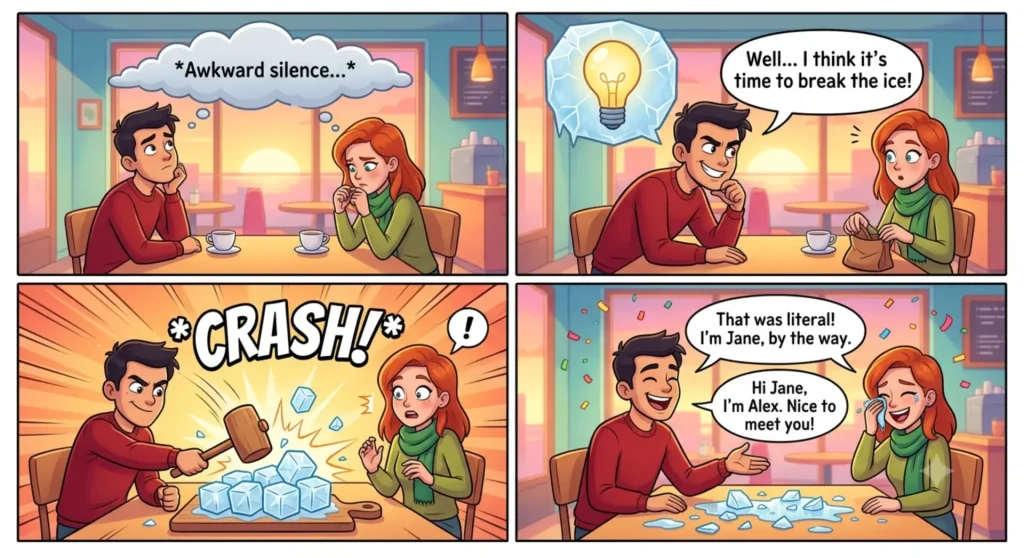
Dialogue: Idiom of Break the Ice in Action
Two colleagues are attending a company workshop for the first time. Nobody knows each other, so the room feels unusually quiet.
- Emma: It’s dead quiet in here, isn’t it?
- Daniel: I know, it’s pretty awkward. Someone should definitely break the ice.
- Emma: Maybe we could strike up a conversation and ask people where they’re traveling this summer.
- Daniel: That’s a solid idea. Everyone loves chatting about their vacation plans.
- Emma: Alright, I’ll give it a shot with the group right behind us.
- Daniel: Sounds good! Once the conversation gets going, the rest will be smooth sailing.
Want more real English like this?
I share practical phrasal verbs, idioms, natural expressions, common mistakes, and short English quizzes on Telegram — in the same clear, everyday style.
Common Mistakes to Avoid
Mistake 1: Dropping the article
- ❌ Wrong: Let’s break ice.
- ✅ Correct: Let’s break the ice.
- Why: This is a fixed phrase. You can’t change or drop any words – it’s always break the ice.
Mistake 2: Mixing up the prepositions
- ❌ Wrong: She broke the ice to her new colleagues.
- ✅ Correct: She broke the ice with her new colleagues.
- Why: When you’re talking about the people you are interacting with, with is the only preposition that sounds natural.
Mistake 3: Using it when there’s no awkwardness
- ❌ Wrong: Every morning I break the ice with my brother.
- ✅ Correct: Every morning I start a conversation with my brother.
- Why: If you already know someone well and feel perfectly comfortable around them, you don’t need to break any ice. Save this phrase for stiff starts and first meetings.
Don’t Confuse It With…
Start a conversation
- The Confusion: Both phrases mean you begin talking to someone.
- The Difference: Start a conversation simply means to begin speaking. Break the ice means to do or say something specific that makes everyone feel comfortable enough to want to talk.
- Example: The teacher asked an easy question to break the ice before the discussion started.
Similar Expressions You Can Use
Ease the tension
- Meaning: To make a stressful or stiff situation feel more relaxed.
- The nuance: This is slightly more formal and works well in both social and high-stakes business environments.
- Example: His calm voice helped ease the tension.
Get the conversation going
- Meaning: To help people start chatting naturally.
- The nuance: This focuses more on keeping the momentum of a chat moving forward rather than overcoming a sudden awkward silence.
- Example: One simple question got the conversation going.
Lighten the mood
- Meaning: To make the atmosphere happier, funnier, or less serious.
- The nuance: You usually use this after a heavy, serious, or overly emotional moment, rather than at a first meeting.
- Example: She told a funny story to lighten the mood.
Opposite and Contrast Expressions
Make things awkward
- Meaning: To create an uncomfortable atmosphere.
- The nuance: This has the exact opposite effect of breaking the ice.
- Example: His rude comment made things awkward.
Create tension
- Meaning: To make people feel anxious, defensive, or uncomfortable.
- The nuance: Instead of opening up communication, it builds a wall and makes chatting incredibly difficult.
- Example: The unexpected question created tension in the room.
Practice Time!
Exercise 1. Context Challenge: Choose the Best Expression
Read the situations carefully and choose the phrase that fits the exact nuance of the context.
- The atmosphere in the courtroom was incredibly heavy after the verdict. The defense lawyer made a gentle, lighthearted comment to __________.
- A) break the ice
- B) lighten the mood
- C) get the conversation going
- Standing in line for the conference badges, nobody was talking. I decided to __________ by asking the guy next to me if he’d traveled far.
- A) break the ice
- B) ease the tension
- C) create tension
- The negotiations were completely stalled, and both teams looked ready to storm out. The mediator called for a coffee break to help __________.
- A) break the ice
- B) start a conversation
- C) ease the tension
Exercise 2. Open Cloze: Grammar & Prepositions
Fill in the blanks with the correct form of the idiom “break the ice” and the missing prepositions where necessary. Don’t forget to change the verb tense if the context requires it!
- I was incredibly nervous about meeting my partner’s parents, but a shared laugh over a clumsy moment completely broke __________ ice __________ them.
- At the upcoming regional summit, we will definitely need a solid strategy to help break __________ ice __________ the two rival delegations before we start the official talks.
- She tried __________ break the ice __________ a quick joke about the terrible traffic, but unfortunately, nobody even cracked a smile.
Exercise 3. Spot and Fix the Blunders
Each of these sentences has a mistake (grammatical, stylistic, or contextual). Find the error and rewrite the sentence so it sounds like natural, fluent English.
- Whenever I call my childhood best friend, I always try to break the ice by asking about her day.
- Our new team leader is great; she managed to break ice at her very first meeting last Tuesday.
- He tried to break the ice to his new project partners, but they immediately jumped straight into the data.
Answer key:
- Exercise 1
- B) lighten the mood. (The situation was heavy/emotional, not a first-time meeting where people are just shy).
- A) break the ice. (Classic context: strangers standing in awkward silence before a conversation starts).
- C) ease the tension. (The situation was stressful and hostile, rather than just socially awkward).
- Exercise 2
- broke the ice with them (Past Simple is needed because the event already happened; “with” is the correct preposition for people).
- to break the ice between the two rival delegations (We use “between” here because it involves two distinct groups).
- to break the ice with a quick joke (Verb pattern “try + to-infinitive”; “with” indicates the tool/method used to break the ice).
- Exercise 3
- Error in context. Close friends don’t have social “ice” between them.
- Correction: Whenever I call my childhood best friend, I always start a conversation / catch up by asking about her day.
- Grammar error (missing article).
- Correction: Our new team leader is great; she managed to break the ice at her very first meeting last Tuesday.
- Preposition error.