
Turn Out Phrasal Verb: How to Talk About Surprising Results
Turn out meaning: to result in a particular way or to prove to be something after the outcome becomes known.
- What Does the Turn Out Phrasal Verb Really Mean?
- How Native Speakers Use “Turn Out” in Real Conversations
- How to Use “Turn Out” in a Sentence Without Overthinking It
- Turn Out Examples That Don’t Sound Like a Textbook
- A Conversation Where “Turn Out” Fits Perfectly
- Words and Phrases Close in Meaning to “Turn Out”
- Is There an Opposite of “Turn Out”?
- The Most Common Mistakes with “Turn Out”
- Practice “Turn Out”: Can You Use It Naturally?
- Quick recap
What Does the Turn Out Phrasal Verb Really Mean?
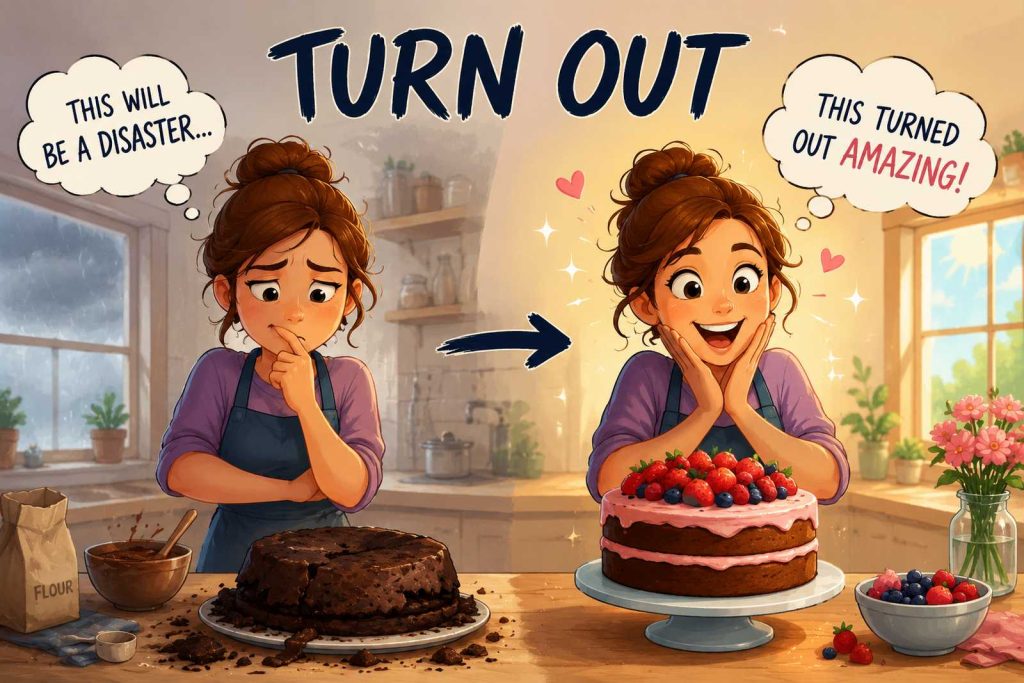
You planned a dinner party and spent hours worrying it would be a disaster. Then the evening ended, the guests left smiling, and you thought: that actually turned out really well. That moment – looking back and seeing how something ended up – is exactly when native speakers reach for turn out.
The core meaning is: to result in a particular way, or to prove to be something you didn’t know before.
The meaning is figurative, not literal. Think of out as “coming to light” – the result was hidden inside the situation, and now it’s emerged. That’s why this phrasal verb always looks backwards: you use it after the outcome is known.
Turn out is neutral – the result can be good, bad, or simply surprising:
- It turned out to be the best decision I ever made.
- The film turned out to be quite boring.
- It turned out that nobody had booked the room.
One more common use: when a large number of people attend an event. – Thousands turned out for the concert.
But the “result” meaning is the one you’ll need most.
How Native Speakers Use “Turn Out” in Real Conversations
Use turn out when you’re reporting a result that wasn’t certain before – a plan, a risk, a guess, a hope. You tried something, waited, and now you know how it went.
A colleague interviews for a job she wasn’t sure about. A week later, she tells you: “It turned out they wanted someone more senior, so I didn’t get it.” She’s not just describing what happened – she’s revealing new information about an uncertain situation. That’s the function of this phrasal verb.
It’s also the natural choice when you’re sharing a surprise or a plot twist in a story: – I thought the café was new. It turns out it’s been there for twenty years. – As it turned out, she already knew the answer.
The phrase as it turned out (or as it turns out for the present) is especially useful when you want to signal that the real situation was different from what you expected.
Avoid using turn out when the result was completely predictable or when you’re describing a planned outcome. If a project went exactly as planned, say it went well – not it turned out well (though this is not wrong, it would imply some prior uncertainty).
How to Use “Turn Out” in a Sentence Without Overthinking It
Patterns
- It turns out + that + clause → sharing new or surprising information
- Subject + turned out + to be + noun/adjective → describing what something proved to be
- How + did + subject + turn out? → asking about a result
Use these patterns when you’re looking back at an uncertain situation and reporting the result.
Common Combinations
|
Common phrase |
Natural context |
|
turn out to be |
describing what something proved to be |
|
it turns out that |
introducing a surprising or new fact |
|
as it turned out |
signalling the real result was different from expected |
|
as it turns out |
present-tense version of the above |
|
turn out well / badly / fine |
describing the quality of a result |
|
everything will turn out for the best |
reassuring someone about an uncertain future |
|
how did it turn out? |
asking about the result of an event or plan |
Quick grammar note
Turn out in the “result” meaning is intransitive – it has no object and cannot be made passive. The two most useful patterns are it turns out that + clause and turned out to be + noun/adjective. Don’t confuse them: it turns out that she was right ✓ but it turns out to she was right ✗.
Turn Out Examples That Don’t Sound Like a Textbook
- I was nervous about the presentation, but it turned out really well.
- It turned out that the hotel had cancelled our booking without telling us.
- We got completely lost, but as it turned out, we found a beautiful village we never would have seen otherwise.
- I thought he was a new employee. It turns out he’s been here for twelve years.
- She turned out to be one of the most talented people I’ve ever worked with.
- The recipe looked complicated, but it turned out to be surprisingly easy.
- How did the job interview turn out?
- Everything will turn out for the best – just give it time.
- It turn out is a very common mistake – don’t forget the s in the third person: it turns out.
- Fewer people turned out to vote than anyone had expected.
A Conversation Where “Turn Out” Fits Perfectly
Two friends are catching up after one of them took a big risk and moved to a new city for a job.
A: So how did the move turn out? You were so stressed about it.
B: Honestly? Much better than I expected.
A: Really? Even the job?
B: Especially the job. My manager is brilliant — really supportive.
A: And the city itself?
B: I thought I’d hate it, but I actually love it. The neighbourhood is amazing.
A: So you’re glad you didn’t give up on the idea?
B: Completely. It turned out to be one of the best decisions I’ve made in years.
Want more real English like this?
I share practical phrasal verbs, idioms, natural expressions, common mistakes, and short English quizzes on Telegram — in the same clear, everyday style.
Words and Phrases Close in Meaning to “Turn Out”
- Meaning: To reach a final state or place, often unexpectedly.
- Difference: End up focuses on where the subject finishes (a place, a state, a situation); turn out focuses on what something proves to be or how it results. Both are informal and very common.
- Example: We ended up staying for an extra week.
Work out
- Meaning: To develop well; to be resolved successfully.
- Difference: Work out usually implies a positive outcome or a problem being solved through effort; turn out is neutral and doesn’t suggest effort – just a revealed result.
- Example: I wasn’t sure about the new arrangement, but it worked out in the end.
Prove to be
- Meaning: To be shown to be true or real over time.
- Difference: More formal than turn out to be – common in written English, reports, and journalism. Use prove to be in formal writing; use turn out to be in conversation and everyday text.
- Example: The investment proved to be a wise decision.
Is There an Opposite of “Turn Out”?
There is no exact opposite expression that learners need to memorize. Turn out describes a result – any result, positive or negative – so there’s no single antonym. If you want to say something went wrong from the start (not as a surprise), use go wrong or fail.
The Most Common Mistakes with “Turn Out”
Mistake 1 – Wrong grammar: “it turns out to” instead of “it turns out that”
- Wrong: It turns out to be raining.
- Correct: It turns out that it’s raining. / It turns out it’s raining.
- Why: After the dummy subject it, use that + a full clause (or drop that informally). Don’t use to directly after it turns out.
Mistake 2 – Confusing “turn out” with “turn up”
- Wrong: My old friend turned out at my door completely unexpectedly.
- Correct: My old friend turned up at my door completely unexpectedly.
- Why: Turn up means to appear or arrive unexpectedly. Turn out describes a result, not an arrival.
Mistake 3 – Confusing “turn out” and “work out”
- Wrong: The plan worked out to be more expensive than we thought.
- Correct: The plan turned out to be more expensive than we thought.
- Why: Work out suggests a process going well or a problem being solved. Turn out describes what something proves to be – the result or nature of a thing. They’re similar, but not interchangeable here.
Mistake 4 – Adding “as” before a noun
- Wrong: It turned out as a disaster.
- Correct: It turned out to be a disaster. / It turned out a disaster.
- Why: Don’t add as before a noun after turn out. Use to be + noun, or skip to be entirely in informal speech.
Mistake 5 – Using the passive
- Wrong: The situation was turned out badly.
- Correct: The situation turned out badly.
- Why: In the “result” meaning, turn out is intransitive – it has no object and cannot be made passive.
Practice “Turn Out”: Can You Use It Naturally?
1.Choose the correct sentence:
a) It turns out to the café was closed.
b) It turns out that the café was closed.
2.Complete the sentence:
The holiday was stressful to organise, but it ________ ________ ________ be one of the best trips we’d ever taken.
3.Correct the mistake:
My old colleague turned out at the conference completely unexpectedly.
4.Which word fits better?
The plan ________ (turned out / worked out) to be more expensive than we expected.
5.Rewrite using “as it turned out”:
We thought the restaurant would be terrible. In fact, it was fantastic.
6.Choose the best expression:
You tried a new recipe and it was delicious. Which sounds most natural?
a) It ended up being delicious.
b) It turned out to be delicious.
c) It proved to be delicious.
Answer key:
- b) It turns out that the café was closed. (use “that” + clause, not “to”)
- turned out to – it turned out to be one of the best trips we’d ever taken.
- Correct: My old colleague turned up at the conference completely unexpectedly. (turn up = arrive/appear; turn out = result)
- turned out – work out implies a process going right; here we’re describing what the plan proved to be.
- As it turned out, the restaurant was fantastic.
- Both a) and b) are natural; c) (proved to be) is slightly too formal for describing a meal. b) is the most typical choice here.

