
Run Out Of Phrasal Verb: Definition, Examples and Common Mistakes
The phrasal verb run out of means that you had something before, but now there is none left, or almost none left. This phrasal verb is often used with time, money, gas, battery, food, paper, ideas, patience, options, and space.

- “Run Out Of” Meaning in Simple English
- When to Use the Phrasal Verb "Run Out Of"
- “Run Out Of” Examples in Sentences
- When Your Battery Runs Out at the Worst Moment
- How to Use “Run Out Of” in a Dialogue
- Synonyms of Run Out Of: Be Out Of, Use Up and Be Low On
- Avoid These Common Mistakes
- Common Phrases with “Run Out Of”
- Practice: Use “Run Out Of” Phrasal Verb Correctly
- Quick recap
“Run Out Of” Meaning in Simple English
You want to make coffee in the morning. You open the fridge, but there is no milk. In English, the natural sentence is not “the milk finished.” You say:
We’ve run out of milk.
The phrasal verb “run out of” means that you had something before, but now there is none left, or almost none left.
You can use this phrasal verb with real, physical things:
- We ran out of milk.
- The car is running out of gas.
- The printer has run out of paper.
You can also use it with abstract things:
- We’re running out of time.
- I’m running out of patience.
- They ran out of ideas.
So the meaning can be both literal and figurative.
The word out helps show the idea that something is gone, finished, or no longer available. You had a supply, but now that supply is empty.
This phrasal verb often has a practical or emotional feeling. If you say We’re running out of time, you are not just saying that time is limited. You are also showing urgency: we need to act soon. If you say I’m running out of patience, it sounds like a warning: I am getting annoyed.
Run out of does not mean “run outside.” It also does not mean “escape.” In this expression, it means that something you need is finished.
Native speakers use this phrase because it sounds natural and everyday. Instead of saying My money finished, English speakers usually say:
I ran out of money.
You may also see the phrase to run out of something. It has the same meaning: a person, place, or thing had a limited supply before, but now there is none left, or almost none left.
When to Use the Phrasal Verb “Run Out Of”
Use run out of when something was available before, but now there is no more, or there is almost no more.
A simple way to understand it:
You had something, you used it, now it is gone or almost gone.
For example, imagine you are driving with friends. The fuel light turns on, and the next gas station is still several miles away. One person looks at the map and says:
We’re running out of gas. Let’s stop soon.
This is exactly the kind of situation where run out of sounds natural. There is a limited supply, the supply is getting low, and now you need to do something.
You can use this phrasal verb in many real situations:
- at home: We’ve run out of bread.
- at work: We’re running out of time before the meeting.
- while travelling: My phone is running out of battery.
- at school: I ran out of time in the exam.
- in emotional conversations: I’m running out of patience.
The phrase often does more than give information. It can show:
- urgency;
- a small problem;
- stress;
- a need to change the plan;
- a warning that something is almost finished.
Sometimes you can use a simpler phrase like be out of:
We’re out of milk.
This also means there is no milk. But we’ve run out of milk focuses more on the fact that the milk was used and now it is gone.
In more formal writing, you may see words like exhaust or deplete, especially with resources:
The company exhausted its resources.
But in normal conversation, run out of is much more natural.
“Run Out Of” Examples in Sentences
- We’ve run out of coffee, so I’ll stop at the shop on my way home.
- After the argument, I completely ran out of words to say.
- We’re running out of time, so let’s discuss the most important point first.
- The printer has run out of paper again. Can you bring some from the storage room?
- Did you run out of gas on the highway?
- I haven’t run out of ideas yet, but I need a short break.
- My phone is running out of battery, so I may not reply right away.
- She ran out of patience after explaining the same rule five times.
- We ran out of seats, so some people had to stand at the back.
- Time is running out, and we still haven’t made a decision.
- I have run out of money, so I’ll have to wait until payday.
When Your Battery Runs Out at the Worst Moment
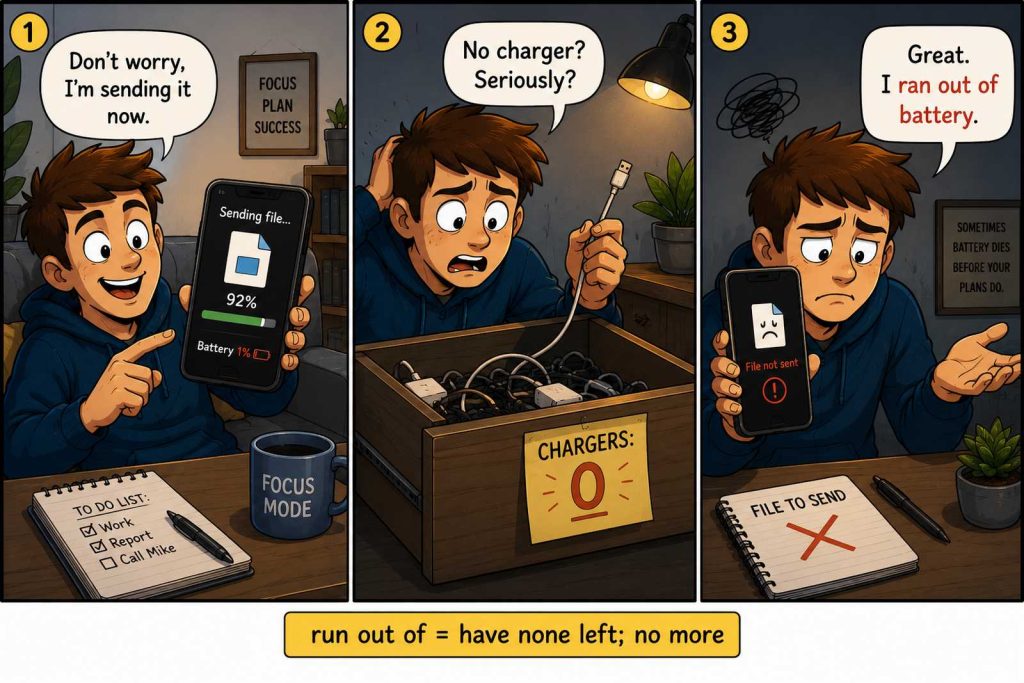
How to Use “Run Out Of” in a Dialogue
Two friends are getting ready for a small dinner at home, but they forgot to check the fridge before cooking.
A: Can you pass me the milk?
B: I can’t. We’ve run out of milk.
A: Really? I thought we bought some yesterday.
B: We did, but I used the last of it for breakfast.
A: Okay, I’ll go to the shop quickly.
B: Good idea. We’re also running out of bread.
A: Anything else?
B: Maybe eggs too. Let’s make a list before you leave.
Want more real English like this?
I share practical phrasal verbs, idioms, natural expressions, common mistakes, and short English quizzes on Telegram — in the same clear, everyday style.
Synonyms of Run Out Of: Be Out Of, Use Up and Be Low On
1. Be out of
Meaning: to have none left.
Difference: Be out of describes the current situation. Run out of shows that something was used and became finished.
Level/tone: A2–B1, neutral, everyday.
Example:
We’re out of milk, so I can’t make pancakes.
Compare:
- We’re out of milk. = There is no milk now.
- We’ve run out of milk. = We had milk, but now it is finished.
2. Use up
Meaning: to use all of something.
Difference: Use up focuses on the action. Run out of focuses on the result.
Level/tone: B1, neutral.
Example:
I used up all the paper while printing the report.
Compare:
- I used up the paper. = I used it all.
- We ran out of paper. = There is no paper left now.
3. Be low on
Meaning: to have only a small amount left.
Difference: Be low on means there is still some left. Run out of means there is none left or almost none left.
Level/tone: B1, conversational.
Example: We’re low on gas, so we should stop soon.
4. Be short of
Meaning: to not have enough of something.
Difference: Be short of often sounds a little more formal or practical. It means you need more, but it does not always mean you have zero.
Level/tone: B1–B2, neutral.
Example: The team is short of staff this week.
5. Exhaust
Meaning: to use something completely.
Difference: Exhaust is more formal than run out of. It is common with words like resources, options, patience, energy.
Level/tone: B2–C1, formal.
Example: They exhausted all possible options before changing the plan.
6. Sell out
Meaning: to have no more products or tickets because they have all been sold.
Difference: Sell out is only about selling. Run out of can be about anything that becomes unavailable.
Level/tone: B1, common.
Example: The concert sold out in one hour.
Compare:
- The shop ran out of bread. = There is no bread left.
- The bread sold out. = All the bread was sold.
Avoid These Common Mistakes
Mistake 1: Missing “of”
- Wrong: We ran out milk.
- Correct: We ran out of milk.
- Why: For this meaning, the thing that is finished comes after of.
Mistake 2: Using the wrong preposition
- Wrong: I ran out from money.
- Correct: I ran out of money.
- Why: The correct phrase is run out of, not run out from. The same rule applies to other prepositions: do not use run out with, run out for, or run out by when you mean that something is finished or no longer available.
Mistake 3: Separating the phrasal verb
- Wrong: We ran milk out of.
- Correct: We ran out of milk.
- Why: Run out of is inseparable. You cannot put the object between run and out.
Mistake 4: Wrong verb form
- Wrong: I have ran out of ideas.
- Correct: I have run out of ideas.
- Why: The verb forms are: run — ran — run
- So in the present perfect, use have run, not have ran.
Common Phrases with “Run Out Of”
|
Common phrase |
Natural context |
|
run out of time |
having too little time left to finish something |
|
run out of money |
having no money left after spending it |
|
run out of cash |
having no cash left to pay for something |
|
run out of funds |
having no money available for a specific purpose |
|
run out of credit |
having no phone credit or available account credit left |
|
run out of gas |
having no fuel left in a car |
|
run out of battery |
when a phone, laptop, or device has almost no power left |
|
run out of milk |
having no milk left at home |
|
run out of coffee |
having no coffee left and needing to buy more |
|
run out of paper |
having no paper left in a printer, office, or classroom |
|
run out of food |
having no food left, often before buying or preparing more |
|
run out of medication |
having no medicine left when you still need it |
|
run out of ideas |
having no more ideas or creative options |
|
run out of patience |
becoming annoyed because you cannot stay calm much longer |
|
run out of options |
having no good choices left |
|
run out of space |
having no more room for people, things, or files |
|
run out of breath |
becoming unable to breathe comfortably after running or physical effort |
|
run out of words |
not knowing what to say in a conversation or emotional situation |
Practice: Use “Run Out Of” Phrasal Verb Correctly
1. Choose the correct option
We need to buy more coffee. We’ve ______ coffee.
a) run out
b) run out of
c) run from
2. Correct the mistake
Wrong sentence: We ran out milk before breakfast.
3. Choose the best sentence
a) I have ran out of ideas.
b) I have run out of ideas.
c) I have run out from ideas.
4. Choose the correct object position
Which sentence is correct?
a) We ran bread out of.
b) We ran out of bread.
c) We ran out bread.
5. Choose the best similar expression
Which sentence is closest in meaning to We’ve run out of milk?
a) We’re out of milk.
b) We sold milk.
c) We found some milk.
6. Rewrite the sentence
Rewrite this sentence using run out of:
There is no paper left in the printer.
7. Write your own example
Write one sentence with run out of about your real life. You can use:
- time
- money
- battery
- patience
- ideas
- coffee
- food
Answer key:
- b) run out of
- We ran out of milk before breakfast.
- b) I have run out of ideas.
- b) We ran out of bread.
- a) We’re out of milk.
- The printer has run out of paper.
- Example answer: My phone is running out of battery, so I need to charge it.

