
Put Off Meaning: The Phrasal Verb That Does More Than Just Delay
Put off meaning: to delay something until later, or to make someone lose interest. Learn the grammar, real-life examples, common mistakes, and the difference between put off, postpone, delay, and call off.
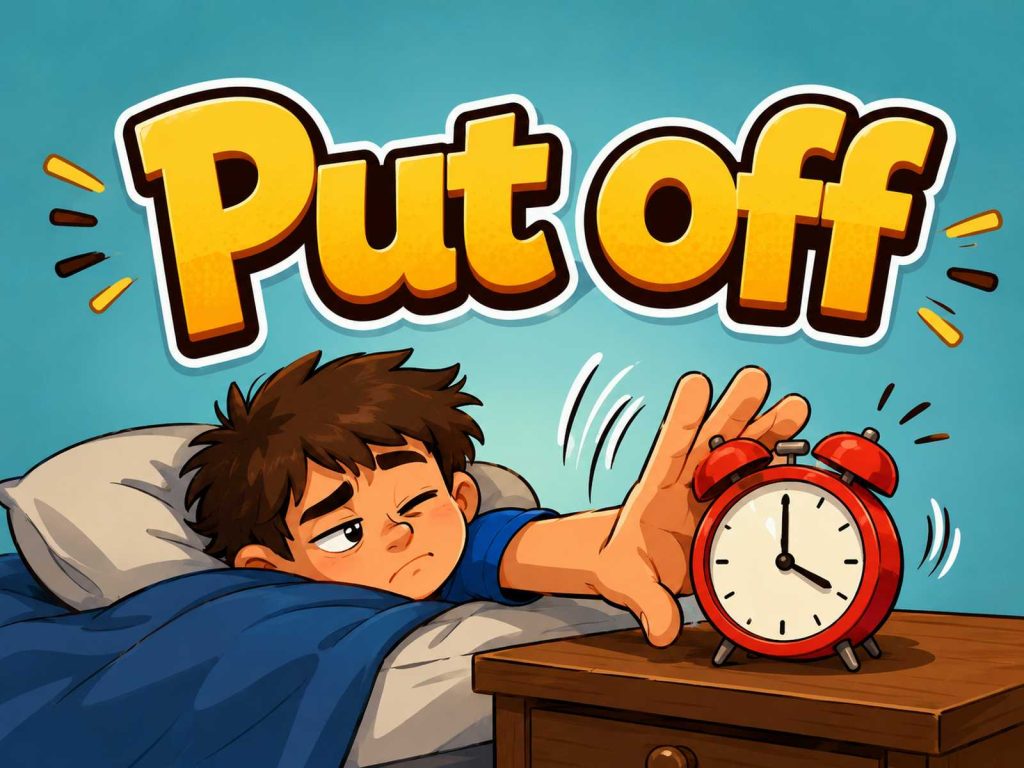
- Understanding the Meaning of "Put Off"
- When Should You Use "Put Off"?
- How to Use "Put Off" in a Sentence
- Common Examples with "Put Off"
- This Is What Happens When You Put Things Off
- Hear It in a Real Conversation
- Avoid These Mistakes
- Expressions That Are Close to "Put Off"
- Expressions with the Opposite Meaning
- Practice
- Quick recap
Understanding the Meaning of “Put Off”
Meaning 1 – to delay or postpone something
You had a plan. You moved it to a later time. That’s the core put off meaning in everyday English.
You’ve probably been there: the dentist appointment you’ve been meaning to book for weeks. The difficult conversation you keep avoiding. The essay you’ll “definitely start tomorrow.” Every time you move something to later – that’s put off. It’s not just a neutral postponement; it often carries a slight sense of avoidance. You’re not just rescheduling. You’re pushing something away because it feels inconvenient, uncomfortable, or just hard to start.
She’s been putting off calling her landlord for two weeks. The leak is getting worse.
Meaning 2 – to make someone lose interest or feel put off by something
This is a second, very different meaning. When something (a smell, a person’s behaviour, a bad review) makes you feel uncomfortable or lose interest – you say you were put off by it. Notice the grammar shift here: the object is always a person, not a task.
The rude tone of the first email completely put her off the company.
A quick note on a third meaning (mainly British English): In British English, put off can also mean to distract someone who’s trying to concentrate. “Stop tapping – you’re putting me off!” This is less common outside the UK, so it won’t be the focus here, but it’s good to recognise.
When Should You Use “Put Off”?
Use put something off when something planned gets moved to a later time – especially when there’s reluctance or a practical obstacle behind the delay.
It sounds natural in everyday conversations, work emails, and informal messages. A colleague sends a quick message: “Can we put the meeting off until Thursday? Something came up.” No drama – just a practical delay. That’s the most common use of this phrasal verb.
It also fits situations with a hint of guilt: the gym session you’ve skipped three times in a row, the form you’ve been meaning to fill out, the apology call you keep finding excuses to avoid. Native speakers use put it off precisely when they want to capture that combination of delay and avoidance.
Use to be put off (meaning 2) when you want to describe a reaction – something changed your mind or made you uncomfortable. It’s softer than “disgusted” but stronger than “a bit bothered.” If a friend says “I was put off by the whole experience,” you understand they’ve lost interest and won’t be going back.
For formal writing – reports, official emails, academic texts – postpone or defer sounds more professional than put off.
How to Use “Put Off” in a Sentence
Pattern:
- put off + noun/noun phrase → put off the meeting, put off the decision
- put + pronoun + off → put it off, put them off
- put off + -ing verb → put off calling, put off going
- be put off + by + noun/phrase → be put off by the price, be put off by his attitude
Use put off with a noun or -ing verb when delaying something. Use be put off by when describing a reaction of aversion or lost interest.
|
Common phrase |
Natural context |
|
put it off until later |
delaying a task or decision |
|
put off the meeting |
rescheduling in a work context |
|
put off delay a decision |
avoiding making a choice |
|
put something off indefinitely |
avoiding something with no new date set |
|
be put off by the price |
losing interest because of cost |
|
be put off by someone’s attitude |
feeling discouraged by how someone behaves |
|
keep putting it off |
habitual procrastination |
Quick grammar note: Put off is separable – the object can go before or after off when it’s a noun (put the meeting off or put off the meeting). But with pronouns, there’s no choice: put it off ✓ – put off it ✗. After put off, always use an -ing verb, never an infinitive.
Common Examples with “Put Off”
- She keeps putting off her doctor’s appointment. She’s been saying “next week” for two months.
- The storm put the outdoor concert off until the following Saturday.
- I know I should call him back, but I keep putting it off – I’m not sure what to say.
- We had to put off the product launch because the app still had too many bugs.
- The long queue outside the museum put a lot of visitors off, and many just left.
- His constant interrupting during the presentation put me off completely.
- Don’t put off applying for the course – the deadline is next Friday.
- She was put off by the smell of the place and suggested they find another café.
- The project review has been put off twice already. Everyone’s getting frustrated.
- That weird message he sent first thing in the morning put her off the whole date.
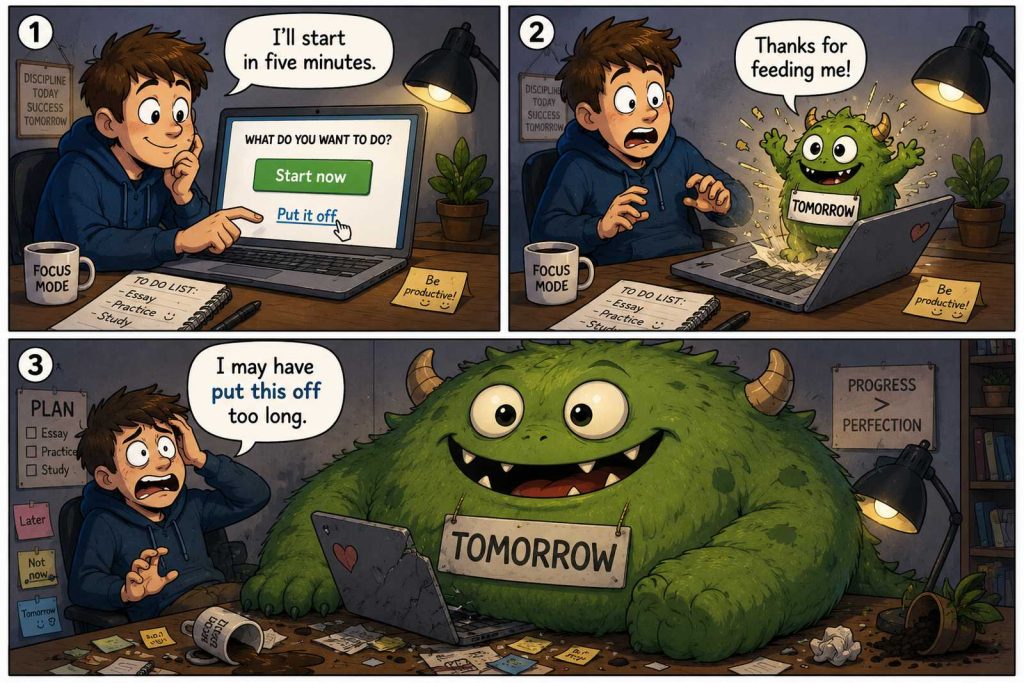
This Is What Happens When You Put Things Off
Hear It in a Real Conversation
Two colleagues are messaging each other on Monday morning after a weekend project issue.
A: Hey – are we still having the team check-in at 2?
B: About that… could we put it off until tomorrow? I haven’t finished the report yet.
A: Tomorrow? Didn’t we already move it once?
B: I know. I’ve been avoiding the report because the data’s a mess. I just need one more day.
A: Fine. But we can’t keep delaying this – the client presentation is Thursday.
B: I get it. Tomorrow at 2, I promise.
Want more real English like this?
I share practical phrasal verbs, idioms, natural expressions, common mistakes, and short English quizzes on Telegram — in the same clear, everyday style.
Avoid These Mistakes
Mistake 1 – Wrong pronoun position
- Wrong: I put off it until Friday.
- Correct: I put it off until Friday.
- Why: When the object is a pronoun (it, them, him, her), it must go between put and off. You cannot put it after. This is the single most common error with this phrasal verb.
Mistake 2 – Infinitive instead of gerund
- Wrong: She put off to call the doctor.
- Correct: She put off calling the doctor.
- Why: After put off, the next verb must be in -ing form. Put off to do is not English.
Mistake 3 – Confusing put off and call off
- Wrong: The match was put off because the team cancelled it. (meaning it won’t happen at all)
- Correct: The match was called off. (cancelled) / The match was put off until next week. (rescheduled)
- Why: Put off means moved to a later time. Call off means cancelled entirely. These are not the same – and mixing them up changes the meaning completely.
Mistake 4 – Missing object
- Wrong: I’ll put off because I’m tired.
- Correct: I’ll put it off because I’m tired.
- Why: Put off always needs an object – what exactly is being delayed or who is being discouraged.
Mistake 5 – Wrong object position with meaning 2
- Wrong: It put off me.
- Correct: It put me off.
- Why: With both meanings, the pronoun goes between the verb and the particle. Put off me sounds unnatural and is grammatically wrong.
Expressions That Are Close to “Put Off”
Postpone
- Meaning: to move an event to a later time
- Difference: More formal than put off; common in official announcements and written English. No pronoun position issues.
- Example: The conference has been postponed until further notice.
Call off
- Meaning: to cancel something completely
- Difference: Call off means it’s not happening at all, while put off delay means it’s simply moved. Use call off for cancellations, not rescheduling.
- Example: They called off the trip when the flights were cancelled.
Procrastinate
- Meaning: to repeatedly delay something because you don’t want to do it
- Difference: Procrastinate describes a habit or pattern – it has no direct object. Put off is about a specific action or decision being delayed.
- Example: He knows he procrastinates, but he still can’t make himself start.
Expressions with the Opposite Meaning
Get on with something
- Meaning: to start or continue doing something without delay
- Difference: The direct contrast to put something off – instead of avoiding it, you just do it.
- Example: Stop putting it off and just get on with it.
Go ahead (with something)
- Meaning: to proceed as planned
- Difference: Used when a plan is confirmed and not delayed, often after a period of uncertainty.
- Example: Despite the bad weather forecast, they decided to go ahead with the event.
Practice
1.Choose the correct sentence:
a) She put off it until Monday.
b) She put it off until Monday.
c) She put off until Monday.
2.Correct the mistake:
I’ve been putting off to start the project for weeks.
3.Which word fits best?
The concert was _______ because the singer was ill – it will happen next month instead.
a) called off
b) put off
c) switched off
4.Choose the right option:
After put off, which form comes next?
a) He put off to call her.
b) He put off calling her.
5.Is this sentence natural?
The board of directors decided to put off the annual meeting. → Would you change it? What might sound more formal?
Answer key:
- b) She put it off until Monday. (pronoun goes between put and off)
- I’ve been putting off starting the project for weeks. (gerund, not infinitive)
- b) put off (rescheduled to later; “called off” = cancelled completely)
- b) He put off calling her. (-ing form required)
- Yes – in formal writing, postpone sounds more appropriate: “The board decided to postpone the annual meeting.”

