
Take Off Phrasal Verb: 5 Meanings, Examples, and Grammar Tips
Take off usually means that something leaves, comes away, or moves from its original position. You can take off your shoes, a plane can take off, or a business can suddenly take off and become successful. The meaning depends on the context.
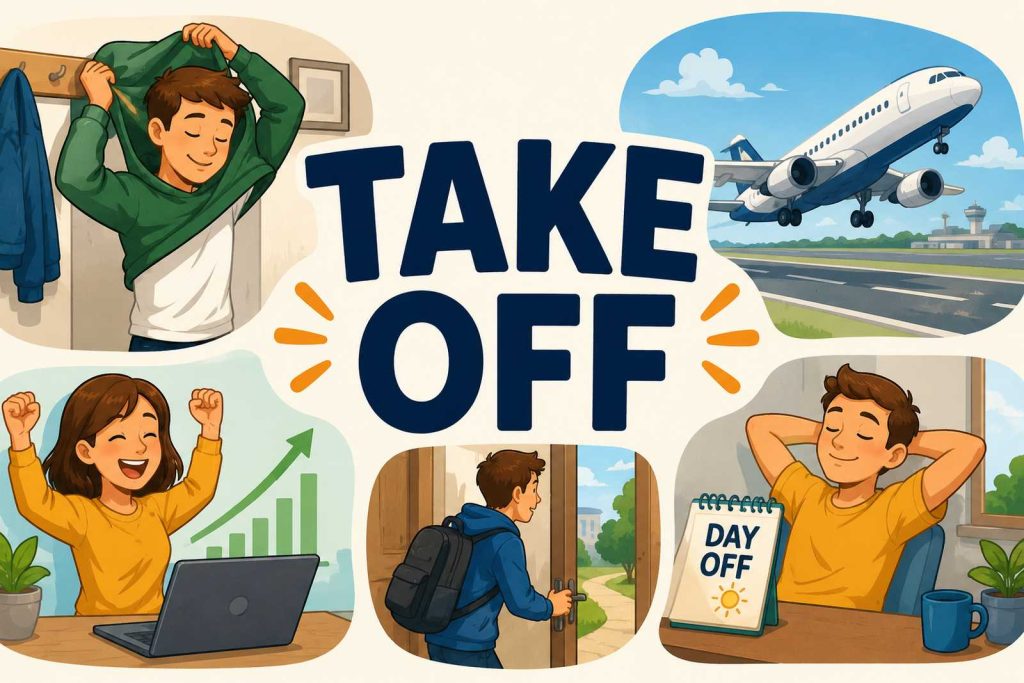
- Take Off Meaning In Five Different Situations
- When Do You Actually Use It?
- How to Use "Take Off" in a Sentence
- Take Off Phrasal Verb in a Sentence – Real Examples
- Hear It in a Real Conversation
- Common Mistakes with “Take Off”
- Take Off Synonyms and Related Phrases
- Opposite or Contrast Expressions
- Take Off Phrasal Verb Exercises
- Quick recap
Take Off Meaning In Five Different Situations
What does “take off” mean? That depends entirely on what’s doing the taking off.
The particle off is your clue. In English, off almost always signals separation – something moves away from a surface, a place, or a starting point. Once you see that, the different meanings of this phrasal verb stop feeling random.
The five main meanings:
- Remove clothing or accessories (literal). You take something off your body – a coat, shoes, gloves, socks. It’s fully physical, and it’s probably the first meaning most learners meet.
She walked in, took off the white gloves, and set them on the table.
- A plane (or rocket) leaves the ground (literal). When an aircraft goes from the ground into the air, it takes off. This is a fixed expression in aviation and everyday travel talk.
The plane took off forty minutes late.
- Become suddenly successful or popular (figurative). A business, song, app, or career takes off when it grows fast and unexpectedly. The image is borrowed from the plane: it goes from zero to moving very quickly.
She started posting cooking videos in January. By spring, her channel had really taken off.
- Leave a place quickly (informal). A person takes off when they leave abruptly – without much warning or explanation. It can sound casual, hurried, or slightly evasive depending on the tone.
He wasn’t enjoying the party, so he just took off around nine.
- Take time away from work. You take a day, week, or holiday off – meaning you don’t work during that period. This is extremely common in everyday workplace conversation.
I’m taking Friday off. I need a break.
Bonus use: In British English, if someone takes off another person, they imitate or mimic them – usually for laughs. She takes off the boss perfectly. This meaning is less common globally but worth knowing.
When Do You Actually Use It?
The most everyday use is removing something you’re wearing – take off a dress when you get home, take off your socks after a long day. It’s the natural, conversational choice. Remove works too, but it sounds stiff and formal; in casual speech, take off is almost always better.
The “success” meaning is the one many learners miss, but it’s everywhere in business English. When a product launches slowly and then suddenly everybody wants it – that’s when it took off. If you read business news or talk about trends, you’ll hear this constantly.
The “leave quickly” meaning is very informal – fine with friends (I’ve got to take off, early start tomorrow), but not for a work email.
One related expression worth knowing: take your mind off something means to stop thinking about a worry. Let’s go out – it’ll take your mind off work. It shares the same off logic (moving away from something), but it functions as a fixed phrase with mind, not as a standalone use of “take off.”
How to Use “Take Off” in a Sentence
Pattern:
- take off + noun (clothing/accessory)
- take + noun + off
- take + pronoun + off (pronoun must go in the middle)
- subject + took off (no object – for planes, success, leaving)
- take + time expression + off (for time away from work)
Use the first three patterns when removing something from your body. Use the no-object pattern when talking about aircraft, careers, or quick departures.
|
Common phrase |
Natural context |
|
take off your shoes / socks |
entering a home, doing yoga, airport security |
|
take off a dress / take the dresses off |
getting home, getting ready, after a long formal event |
|
take off the white gloves |
finishing a formal occasion, starting something messy |
|
took off overnight |
a product, song, or trend growing very fast |
|
take a day / week off |
workplace conversation, planning a break |
|
take off without a word |
leaving suddenly with no explanation |
|
take your mind off it |
stop thinking about a worry (fixed phrase) |
Quick grammar note: “Take off” is separable when it means removing clothing – both take off the dress and take the dress off are correct. But when the object is a pronoun, separation is not optional: take it off ✓ / take off it ✗. For planes, success, and leaving quickly, there is no object at all.
Take Off Phrasal Verb in a Sentence – Real Examples
- She took off her dress as soon as she got home from the wedding.
- Can you take off your socks? We’re about to do yoga.
- It was hot in the waiting room, so he took his jacket off.
- The flight took off on time for once – I was shocked.
- Their podcast really took off after that interview went viral.
- I need to take a few days off. I haven’t stopped since March.
- She took off without saying goodbye, which felt a bit rude.
- Just take it off and try the other one – you’ve got time.
Hear It in a Real Conversation
Two friends are talking before a weekend trip. One of them is rushing to pack.
A: Wait, are you still packing? The taxi’s in twenty minutes.
B: I know, I know. I can’t find my other shoe.
A: Just take off the one you’re wearing and check under the bed.
B: Found it. Okay. Do you think the flight will take off on time?
A: It said no delays. We should be fine.
B: Great. I’ve been so stressed at work – I really need this trip.
A: Same. I’ve taken the whole week off. First time in ages.
B: Lucky you. Right, I’m ready. Let’s take off.
Want more real English like this?
I share practical phrasal verbs, idioms, natural expressions, common mistakes, and short English quizzes on Telegram — in the same clear, everyday style.
Common Mistakes with “Take Off”
Mistake 1
- Wrong: Take off it when you get inside.
- Correct: Take it off when you get inside.
- Why: When the object is a pronoun (it, them, her), it must go between the verb and the particle. This is a hard rule – take off it is never correct.
Mistake 2
- Wrong: Take out your shoes before you come in.
- Correct: Take off your shoes before you come in.
- Why: Take out means removing something from a container or enclosed space (take a book out of a bag). For clothing and things worn on the body, always use take off. This is one of the most common mix-ups learners make.
Mistake 3
- Wrong: The plane took off the runway.
- Correct: The plane took off from the runway.
- Why: When talking about a plane leaving the ground, “take off” is intransitive – it doesn’t take a direct object. From is a separate preposition here, not part of the phrasal verb. Adding a noun directly after “took off” changes or breaks the meaning.
Mistake 4
- Wrong: I need to take a day.
- Correct: I need to take a day off.
- Why: Without the particle, the meaning is completely lost. Off is what makes this expression work – don’t drop it.
Take Off Synonyms and Related Phrases
Remove
- Meaning: to take something away from a place or body
- Difference: More formal and clinical – used in signs, medical contexts, or official instructions. In everyday conversation, take off is almost always more natural.
- Example: Passengers are required to remove their shoes at security. (formal sign) – but a friend would say: Take off your shoes!
Head off / set off
- Meaning: to leave a place, especially to start a journey
- Difference: Less abrupt than take off. Set off often implies a planned departure; take off (when used for leaving) is usually more sudden or informal.
- Example: We set off early to avoid the traffic.
Skyrocket
- Meaning: to increase or grow very fast
- Difference: Skyrocket emphasizes a dramatic, sharp rise – often used for prices or numbers. Took off is a bit more general and softer. Both are informal.
- Example: After the review, demand for the product skyrocketed.
Opposite or Contrast Expressions
Put on
- Meaning: to place clothing or accessories on your body
- Difference: The direct opposite of “take off” in the clothing sense. If you take off a dress, you put on something else.
- Example: She put on the white gloves before the ceremony.
Land
- Meaning: for an aircraft to come down from the air and touch the ground
- Difference: The opposite of “take off” in the aviation sense.
- Example: The plane landed safely despite the storm.
Take Off Phrasal Verb Exercises
1.Choose the correct option:
He saw his ex-girlfriend across the room and immediately _____.
a) took off
b) took out
c) set off
2.Rewrite the sentence using a pronoun correctly:
She took off her coat. → She took _____ off.
3.Correct the mistake:
I need to take a Monday.
4.Choose the best option:
Their first product was slow to sell, but after a review in a big magazine, it really _____.
a) took off
b) took out
c) headed off
5.Which sentence is correct?
a) Please take off it before entering.
b) Please take it off before entering.
6.Complete the sentence:
I’m exhausted. I’ve decided to take _____ next week.
7.Choose the right word:
It was too hot inside, so I took _____ my jacket.
a) out
b) off
c) away
Answer key:
- a – took off (he left quickly and suddenly)
- She took it off. (pronoun goes between verb and particle)
- I need to take Monday off.
- a – took off (sudden success/popularity)
- b – Please take it off before entering.
- Take the whole week off / take a few days off (or similar)
- b – off

