
What’s the Catch Meaning: When a Good Deal Starts to Feel Suspicious
What’s the catch meaning is the idea of a hidden downside: someone offers you something that sounds good, but you suspect there may be a condition, cost, or problem they have not mentioned yet.

- Why People Ask “What’s the Catch?” Before Saying Yes
- How to Use “What’s the Catch?” Grammatically
- Is “What’s the Catch?” Polite or Too Direct?
- “What’s the Catch?” in a Short Conversation
- The Dream Job That Was Too Good to Be True
- Mistakes to Avoid with “What’s the Catch?”
- Softer Ways to Ask “What’s the Catch?”
- Practice: Would You Really Say “What’s the Catch?”
- Quick recap
Why People Ask “What’s the Catch?” Before Saying Yes
A friend says, “I got us free concert tickets.”
Nice, right? But then you stop for a second. Concert tickets are usually expensive. People do not often give them away for no reason. So before you get too excited, you ask:
“Free tickets? What’s the catch?”
What’s the catch meaning is about that small moment of doubt. You use this phrase when something sounds good, but you think there may be a hidden problem, condition, cost, or downside.
It is not about literally catching something. Here, catch means the part of the offer that someone has not told you yet — the rule, the risk, the extra payment, or the small detail that makes the offer less perfect.
So “What’s the catch?” is a natural way to say:
“This sounds good, but what am I missing?”
For example, a free trial may sound great until you learn that it renews automatically. A cheap apartment may look perfect until you find out it is next to a noisy road. A friend may offer to help you, but maybe they want a favor back later.
That is the feeling behind the phrase: something looks good on the outside, but you want to know what is hidden underneath.
Compare these two questions:
“What’s the problem?” means something is already wrong.
“What’s the catch?” means something looks good, but you suspect there may be a hidden problem.
How to Use “What’s the Catch?” Grammatically
“What’s the catch?” is a fixed question. In normal conversation, people usually say it exactly like this:
What’s the catch?
You can also use the full form:
What is the catch?
The full form is correct, but it sounds a little slower and more serious. In everyday spoken English, “What’s the catch?” is more natural.
The small word the is important here. In this question, we say the catch because we are asking about the specific hidden problem in this offer or situation.
But be careful: a catch is correct in another pattern: There’s a catch.
That means “There is a hidden problem.” So the article changes with the structure:
What’s the catch? = asking about the hidden problem
There’s a catch. = saying that a hidden problem exists
You can also make the question softer or more specific:
Is there a catch? — softer and less direct
What’s the catch here? — about this situation
So what’s the catch? — casual, a little skeptical
What’s the catch, exactly? — asking for clear details
Here are the most useful grammar patterns:
|
Pattern |
How it works |
Example |
|
What’s the catch? |
Ask about the hidden problem. |
This price is very low. What’s the catch? |
|
Is there a catch? |
Ask in a softer way. |
It sounds like a good deal. Is there a catch? |
|
There’s a catch. |
Say that a hidden problem exists. |
You can join for free, but there’s a catch. |
|
The catch is that + sentence |
Explain the hidden problem. |
The catch is that you have to pay later. |
|
with a catch |
Show that something has a hidden condition. |
They offered me a free upgrade, but with a catch. |
|
No catch. / There’s no catch. |
Say there is no hidden problem. |
It’s free. No catch. |
One more useful form is the catch is + noun:
The catch is the price.
The catch is the early start.
Is “What’s the Catch?” Polite or Too Direct?
“What’s the catch?” is normal in spoken English. You can use it with friends, in casual messages, in online comments, or when you talk about deals, prices, apps, subscriptions, and offers.
But the phrase has a suspicious edge. It tells the other person, “I like what I hear, but I’m not ready to trust it yet.”
With friends, that can sound funny:
“You’re giving me your old bike? What’s the catch?”
In a more serious or polite situation, be careful. If someone is trying to help you, “What’s the catch?” may sound like you think they have a hidden plan.
A softer version is better in work emails or formal conversations:
“Are there any conditions I should know about?”
“Are there any limitations?”
“What are the terms?”
So, is “What’s the catch?” rude? Not usually. It depends on your voice, your relationship, and the situation. With a close friend, it can be playful. With a manager, client, or stranger, it may sound too direct.
“What’s the Catch?” in a Short Conversation
Two friends are looking for a hotel for a weekend trip.
A: Look at this hotel. It’s only $45 a night.
B: That’s much cheaper than the others. What’s the catch?
A: Let me check… Oh, the price doesn’t include taxes or the cleaning fee.
B: How much is it with everything included?
A: Almost $90 a night.
B: Okay, now it makes sense.
Want more real English like this?
I share practical phrasal verbs, idioms, natural expressions, common mistakes, and short English quizzes on Telegram — in the same clear, everyday style.
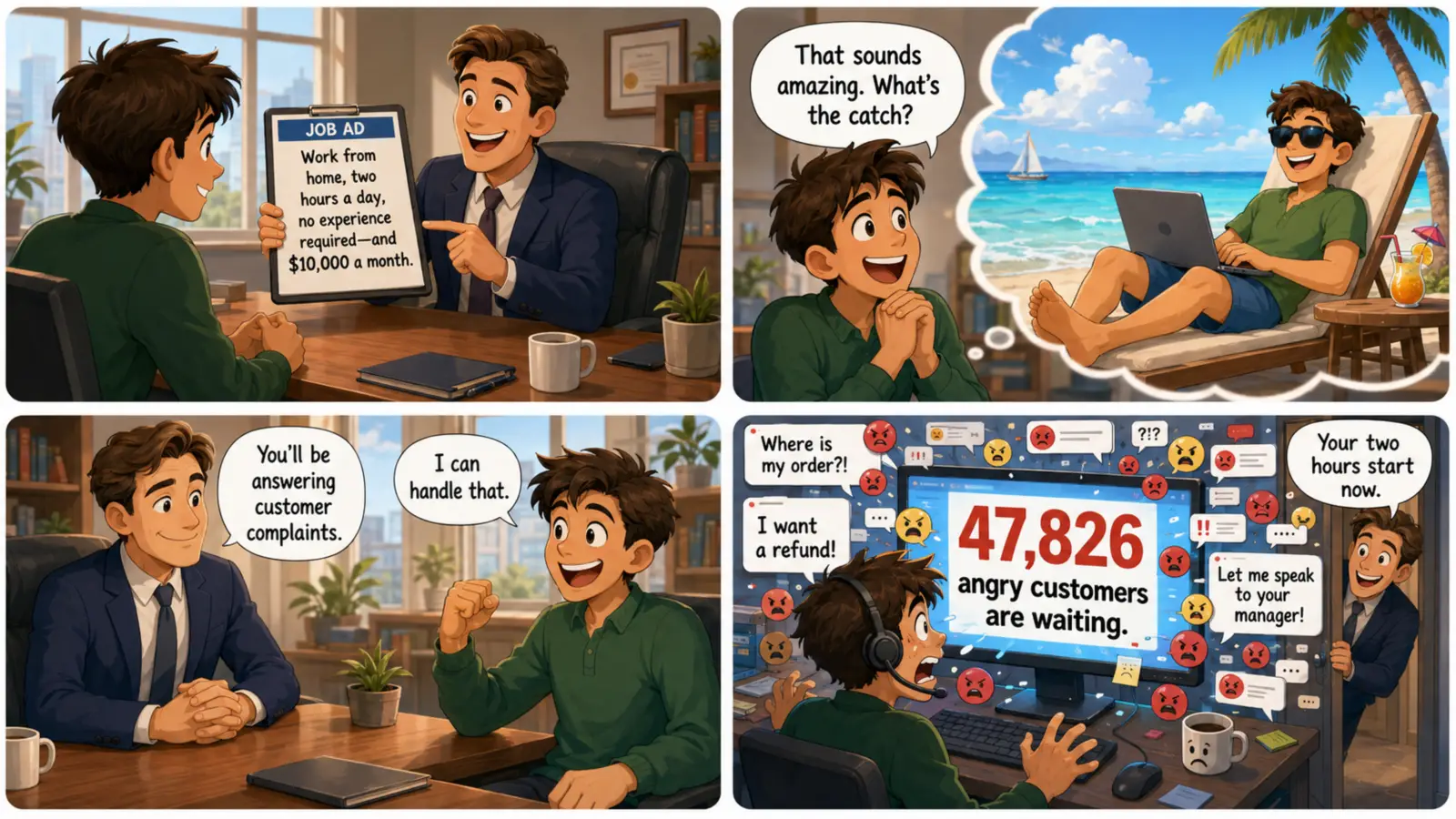
The Dream Job That Was Too Good to Be True
Mistakes to Avoid with “What’s the Catch?”
Mistake 1: Forgetting “the”
- Wrong: What’s catch?
- Correct: What’s the catch?
- You need the because the question is about a specific hidden problem in a specific offer. Without it, the phrase sounds unfinished.
Mistake 2: Using “a” in the question
- Wrong: What’s a catch?
- Correct: What’s the catch?
- Use the catch in the question, but a catch in the statement “There’s a catch.”
Mistake 3: Using it for a normal problem
- Wrong: My phone battery died. What’s the catch?
- Correct: My phone battery died. What’s wrong?
- Use “What’s the catch?” when something seems positive first: a free offer, a cheap price, a generous favor, or a very easy deal. If the situation is simply bad from the start, use “What’s wrong?” or “What’s the problem?”
Softer Ways to Ask “What’s the Catch?”
Is there a catch?
This means almost the same thing, but it sounds softer. It is a good choice when you do not want to sound too suspicious.
Example: This deal looks great. Is there a catch?
Are there any strings attached?
Use this when you think the offer may come with obligations — maybe you have to do something, agree to something, or give something back later.
Example: They offered to pay for the course, but are there any strings attached?
What’s the downside?
This sounds more neutral and practical. You are not strongly suggesting that someone is hiding something; you are simply asking about the negative side.
Example: The plan could save money, but what’s the downside?
Practice: Would You Really Say “What’s the Catch?”
1.A hotel room is much cheaper than every other room in the area. What would you ask?
A. What’s wrong?
B. What’s the catch?
C. What did you catch?
2.A company offers you a “free” tool for your business, but you have not read the conditions yet. Choose the best follow-up.
A. Sounds useful. Are there any fees or conditions I should know about?
B. Sounds useful. Why is your company bad?
C. Sounds useful. What did you catch?
3.Your friend says, “I’ll help you move on Saturday. No problem.” You know they usually hate moving. What sounds natural and friendly?
A. Really? What’s the catch?
B. Really? What’s the problem with you?
C. Really? What’s the downside of your personality?
4.The offer says: “First month free.” Later you learn: “After that, it renews automatically for $39 a month.” Complete the sentence.
The catch is that ______________________________.
5.You are writing a polite email about a scholarship offer. Which version is safer?
A. Thank you for the offer. What’s the catch?
B. Thank you for the offer. Are there any conditions I should know about?
6.Decide if “What’s the catch?” sounds natural here.
“My laptop won’t turn on. What’s the catch?”
Natural or not natural? Why?
7.Choose the better phrase.
You are in a business meeting. The plan could save money, but you want to ask about possible disadvantages without sounding suspicious.
A. What’s the catch?
B. What’s the downside?
8.Rewrite the sentence using “There’s a catch.”
“The course is free, but you have to watch ads before every lesson.”
Answer key:
- B — because the price looks good first, so you suspect a hidden reason.
- A — because this is a company offer, so a softer, more specific question sounds better.
- A — because with a friend it can sound playful, not rude.
- The catch is that it renews automatically for $39 a month — because this explains the hidden condition.
- B — because it is more polite and professional.
- Not natural — because the laptop problem is already bad; there is no attractive offer first. Say “What’s wrong?” instead.
- B — because “What’s the downside?” sounds more neutral and businesslike.
- The course is free, but there’s a catch: you have to watch ads before every lesson — because “there’s a catch” introduces the hidden condition.

