On Cloud Nine Meaning: When Happiness Feels Bigger Than “Happy”
If you are on cloud nine, you feel extremely happy, usually because something wonderful has just happened.

- What Does “On Cloud Nine” Mean?
- When Native Speakers Say “On Cloud Nine” – Situations, Tone, and Naturalness
- Examples of “On Cloud Nine” in a Sentence
- Grammar Patterns with “On Cloud Nine”
- She Said Yes!
- “On Cloud Nine” in a Short Dialogue
- Avoid these mistakes
- Don’t Confuse “On Cloud Nine” with Similar Happy Idioms
- Similar Expressions for Feeling Very Happy
- Opposite or Contrast Expressions
- Practice Time!
- Quick recap
What Does “On Cloud Nine” Mean?
You refresh the university website one more time. This time, the word Accepted appears on the screen. You scream, call your best friend, and say, “I’m on cloud nine!”
That is the basic on cloud nine meaning: you feel extremely happy because something wonderful has happened. The idiom is figurative, not literal – no one is really sitting on a cloud. The image is about feeling so light with joy that you almost seem to float above the ground.
A simple word like happy may feel too weak here:
- I was happy to get the email. = normal happiness
- I was on cloud nine when I got the email. = much stronger happiness
If someone asks you to define on cloud nine, think of this pattern:
Good news → big emotional reaction → “I’m on cloud nine.”
A quick note on the on cloud 9 origin: people explain the number nine in different ways. Some connect it with cloud types, while others see nine as a number that makes the image sound higher and more emotional. For learners, the exact origin matters less than knowing when the idiom sounds natural.
When Native Speakers Say “On Cloud Nine” – Situations, Tone, and Naturalness
Native speakers say on cloud nine when happiness feels big, personal, and emotional. It is not usually for tiny everyday pleasures, unless you are joking.
You can use it after a job offer:
She got the position she wanted, and now she’s on cloud nine.
You can use it after an exam result:
I was on cloud nine when I saw that I had passed.
It also sounds natural after university acceptance, a sports win, romantic news, a new baby in the family, or a dream coming true. You might see it in a social media caption too:
Accepted into my dream program. I’m on cloud nine!
This idiom is informal and conversational. It works well in daily conversation, friendly messages, casual workplace chat, interviews after a win, and emotional personal stories.
It is not the best choice for academic essays, legal writing, formal business reports, or very serious professional announcements. In those situations, use a calmer phrase such as delighted, thrilled, extremely pleased, or very happy.
Examples of “On Cloud Nine” in a Sentence
- I’m on cloud nine – I just got the job offer!
- She was on cloud nine after passing her final exam.
- They were on cloud nine when their team won the championship.
- He’s been on cloud nine since his daughter was born.
- I was on cloud nine when I found out I’d been accepted into university.
- You look like you’re on cloud nine. What happened?
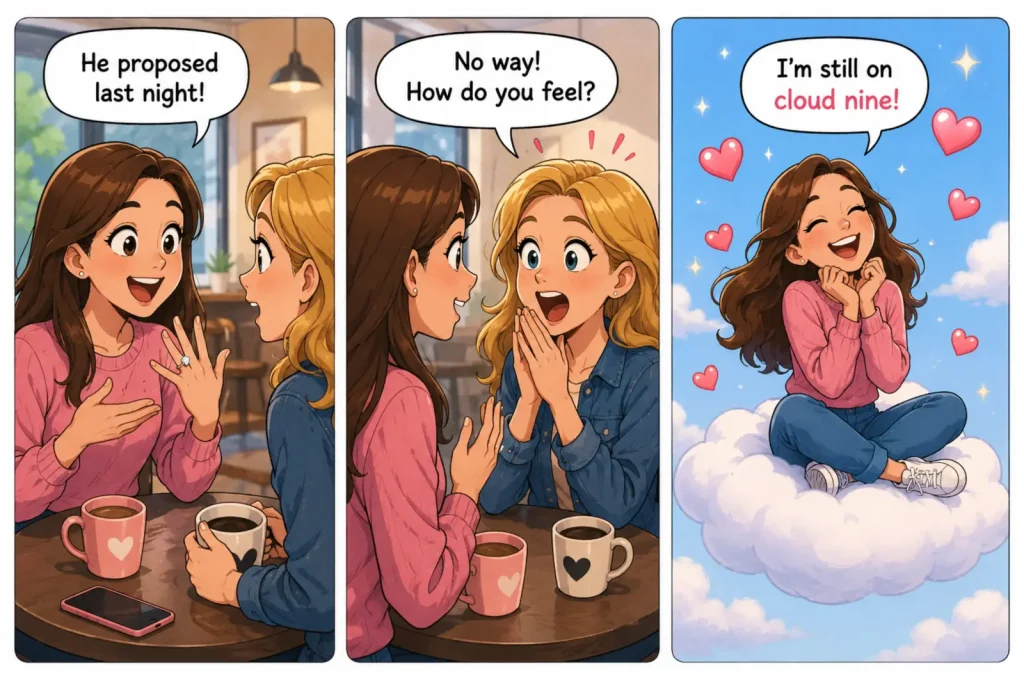
- She’s on cloud 9 after getting engaged last night.
- We were not exactly on cloud nine after the meeting, but at least the news was better than expected.
- Got my visa approved today – on cloud nine right now!
- My brother has been on cloud nine ever since he passed his driving test.
Notice that many examples explain the reason with after, when, since, or because. That is very common because the idiom usually comes after a clear happy event.
Grammar Patterns with “On Cloud Nine”
|
Pattern |
How to use it naturally |
|
I’m / she’s / they’re on cloud nine. |
Use it as a short reaction to very good news. Example: I got the job – I’m on cloud nine! |
|
was / were on cloud nine |
Use it when telling a story about a happy moment in the past. Example: I was on cloud nine when I saw my exam result. |
|
on cloud nine after + noun / -ing |
Use after to give the reason. Example: She was on cloud nine after winning the prize. |
|
on cloud nine when + clause |
Use when to describe the moment the happy feeling started. Example: They were on cloud nine when their team won. |
|
have / has been on cloud nine since… |
Use since when the happiness started earlier and continues now. Example: He’s been on cloud nine since his daughter was born. |
|
feel like I’m on cloud nine |
Use this when you want the phrase to sound more personal and emotional. Example: I feel like I’m on cloud nine today. |
|
look like you’re on cloud nine |
Use this when someone looks visibly happy or excited. Example: You look like you’re on cloud nine – what happened? |
In informal messages or captions, people sometimes write cloud 9, as in she’s on cloud 9. In normal writing, cloud nine looks more polished and natural.
She Said Yes!
“On Cloud Nine” in a Short Dialogue
Two friends are talking after Mia checks her exam results. She was worried all morning because the exam was important for her university application.
Lena: You look like you’re on cloud nine. Did something happen?
Mia: I passed the exam – and not just passed. I got one of the highest scores in the class.
Lena: Mia, that’s amazing! You were so nervous about it last week.
Mia: I know. I barely slept last night, and now I feel like I’m on cloud nine.
Lena: You should. You worked for months, and it finally paid off.
Mia: Honestly, I keep checking the result because I still can’t believe it.
Lena: Well, believe it. Let’s go celebrate after class.
Mia: Absolutely. I’ve been waiting for good news like this all semester.
Want more real English like this?
I share practical phrasal verbs, idioms, natural expressions, common mistakes, and short English quizzes on Telegram — in the same clear, everyday style.
Avoid these mistakes
Mistake 1: using the wrong preposition
- Wrong: I’m in cloud nine.
- Correct: I’m on cloud nine.
- Why: The fixed idiom uses on, not in.
Mistake 2: adding “the”
- Wrong: She is on the cloud nine.
- Correct: She is on cloud nine.
- Why: There is no article in this idiom. Say on cloud nine, not on the cloud nine.
Mistake 3: forgetting the verb “be”
- Wrong: I cloud nine after the exam.
- Correct: I was on cloud nine after the exam.
- Why: The normal pattern is be on cloud nine: I am, she is, they were, we have been.
Don’t Confuse “On Cloud Nine” with Similar Happy Idioms
Over the moon
- Difference: On cloud nine vs over the moon is a very small difference; both are informal, but over the moon is especially common in British English and often sounds a little more everyday.
- Example: She was over the moon when she got the job.
In seventh heaven
- Difference: In seventh heaven also means extremely happy, but it can sound a little more literary or old-fashioned than on cloud nine.
- Example: He was in seventh heaven after the concert.
Similar Expressions for Feeling Very Happy
Walking on air
- Meaning: feeling extremely happy and light.
- Difference: It focuses more on the feeling of lightness after good news.
- Example: She’s been walking on air since she heard the news.
Thrilled
- Meaning: very pleased and excited.
- Difference: It is not an idiom, so it is easier to use in both spoken and semi-formal English.
- Example: We’re thrilled to have you on the team.
Ecstatic
- Meaning: extremely happy, almost overwhelmed with joy.
- Difference: It is stronger and more dramatic than happy or thrilled.
- Example: The fans were ecstatic after the final goal.
Opposite or Contrast Expressions
Down in the dumps
- Meaning: sad or unhappy.
- Difference: This is an informal opposite of feeling joyful or excited.
- Example: He’s been down in the dumps since he lost the match.
Feeling low
- Meaning: feeling sad, tired, or emotionally weak.
- Difference: It is more neutral and less idiomatic than down in the dumps.
- Example: I’ve been feeling low this week.
Practice Time!
1.Which sentence sounds most natural after someone gets accepted into their dream university?
a) I’m quite okay about it.
b) I’m on cloud nine.
c) I’m on the cloud nine.
2.Correct the mistake:
She’s been in cloud nine since she got the job offer.
3.Choose the best ending:
I was on cloud nine when…
a) I couldn’t find my pen.
b) I saw that I had passed the exam.
c) I cleaned my room.
4.Which sentence is better for a formal company announcement?
a) We are on cloud nine to share our annual report.
b) We are pleased to share our annual report.
5.Rewrite the sentence using on cloud nine:
She was extremely happy after winning the competition.
6.Which sentence sounds more natural in casual conversation?
a) You look like you’re on cloud nine. What happened?
b) You are physically positioned on cloud nine. What happened?
7.Choose the better idiom:
He became a father yesterday, and he’s been ______ ever since.
a) over the moon
b) under the weather
c) in hot water
8.Is this use natural, too strong, or humorous?
I finally found a clean spoon, so I’m on cloud nine.
9.Choose the better sentence for a social media caption:
a) Got accepted into my dream program. I’m on cloud nine!
b) I hereby announce that I am emotionally satisfied with my admission result.
Answer key:
- b – because the idiom fits strong happiness after important good news.
- She’s been on cloud nine since she got the job offer – because the fixed phrase uses on, not in.
- b – because passing an exam can cause a strong happy reaction.
- b – because pleased is more natural in formal business writing.
- Possible answer: She was on cloud nine after winning the competition – because after explains the reason for the happiness.
- a – because look like you’re on cloud nine is a natural way to notice someone’s happiness.
- a – because over the moon also means extremely happy.
- Usually humorous – because the situation is too small for such a strong idiom unless the speaker is joking.
- a – because on cloud nine sounds natural in emotional, informal social media posts.