
Use Up Phrasal Verb: When Every Last Bit Is Gone
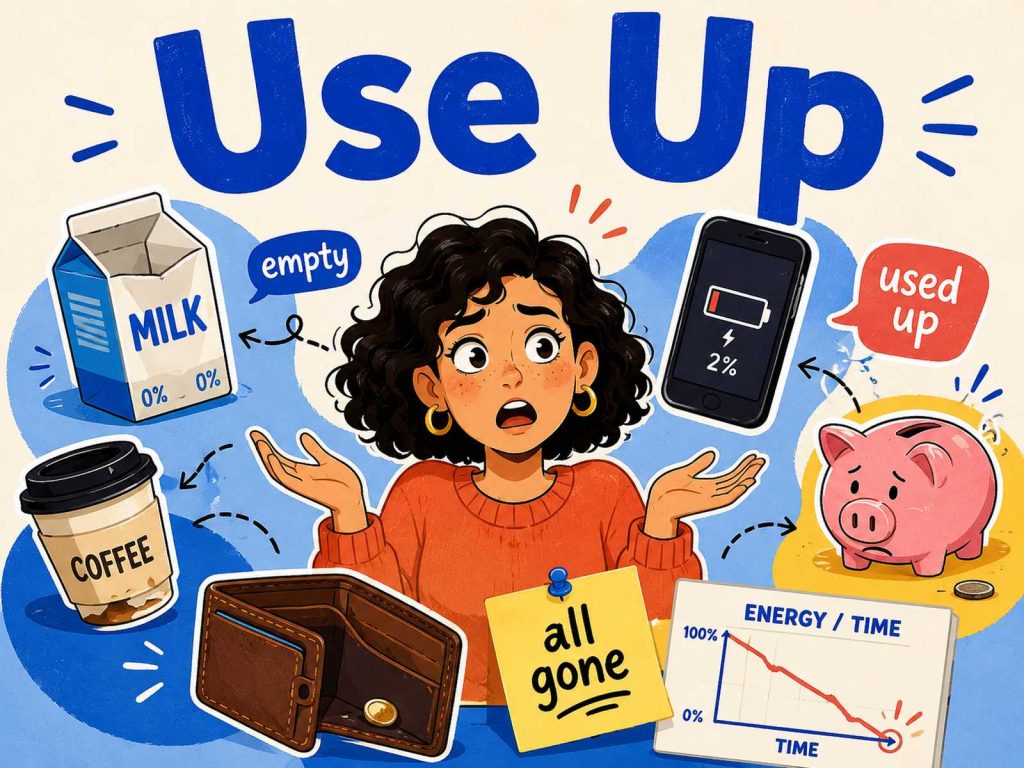
Use up means to finish the entire supply of something so that nothing is left. It works for physical things like food, money, or battery – and for abstract resources like energy, time, or patience.
- What Does "Use Up" Phrasal Verb Mean?
- When to Use "Use Up" in Everyday English
- Use Up Phrasal Verb: Examples in a Sentences
- Use Up Phrasal Verb: Grammar and Common Phrases
- Use "Use Up" in a Dialogue
- Use Up vs Run Out Of: Similar Expressions and Differences
- Opposite or Contrast Expressions
- Avoid These Mistakes
- Practice
- Quick recap
What Does “Use Up” Phrasal Verb Mean?
You open the fridge to make breakfast, and the milk is gone. Your flatmate finished it last night. Every drop. That’s exactly when a native speaker would say: “Who used up all the milk?”
Use up means to consume or finish the entire supply of something, leaving nothing behind. The key idea is all of it – not just some, but everything. When something has been used up, it’s gone.
The particle up here signals completion. Think of eat up, drink up, finish up – in each case, up tells you the action is done fully, to the very end. Use up follows the same logic: you don’t just use something, you use it completely.
This phrasal verb works for physical things – food, money, paper, battery, storage – and for abstract resources too: energy, time, patience, creativity. Both uses are equally natural in everyday English.
“I used up the last of my savings on that trip.”
“Three hours of back-to-back meetings used up every bit of energy I had.”
One thing to note: use up is not the same as simply use. “She used the shampoo” means she used some of it. “She used up the shampoo” means it’s finished – the bottle is empty.
When to Use “Use Up” in Everyday English
Use this phrasal verb when you want to emphasise that a resource has reached zero – nothing is left.
It appears naturally in two kinds of moments. The first is practical and often slightly frustrated: you needed something, and it’s gone. “Someone used up all the printer paper.”
The second is more reflective: you’re explaining why you feel drained or why time ran out. “That project used up three months of my life.”
You’ll hear it often in domestic situations, at work when budgets or supplies are tight, and in personal conversations about energy or time. It fits informal messages, casual emails, and everyday speech – but it’s too casual for academic writing, where exhaust or deplete would be more appropriate.
Here’s a small but real situation: a friend calls you on a Sunday afternoon and suggests going out. You want to say yes, but after a full week of work and a difficult family weekend, there’s nothing left in you. You don’t say “I am very tired.” You say: “I honestly can’t – I’ve used up all my energy this week.” That single phrase says everything.
Use Up Phrasal Verb: Examples in a Sentences
- She used up all the hot water before I even got to the shower.
- We’ve nearly used up our monthly data – slow down on the video streaming.
- Don’t use up all the coffee. I need some in the morning.
- He used up his annual leave in January and now he can’t take a summer holiday.
- Running those reports uses up most of my Tuesday afternoon.
- I’ve used it up already – sorry, I should have told you sooner.
- Have you used up all the printer ink again?
- The renovation project used up their entire savings.
- Three days of tough negotiations used up her patience completely.
- I try not to use up my energy on things I can’t control.
Use Up Phrasal Verb: Grammar and Common Phrases
Pattern: subject + use up + noun / pronoun + (time or place expression)
Use this structure when you want to say that a supply of something – physical or abstract – has been completely consumed.
Is use up separable?
Yes. Use up is a separable phrasal verb, which means a noun object can go either after the full verb or between the verb and up. You can say use up the milk or use the milk up. Both are correct. But with pronouns, the object must go in the middle: use it up, use them up, use all of it up. Do not say use up it.
|
Common phrase |
Natural context |
|
use up all the milk / coffee / food |
Noticing a supply is gone at home |
|
use up the budget / savings |
Work, finance, or planning situations |
|
use up your energy / patience |
Expressing emotional or physical exhaustion |
|
use up storage / data |
Tech and digital contexts |
|
use up time / days off |
Schedules, deadlines, leave management |
|
use up leftovers |
Cooking and reducing food waste |
- This app uses up battery incredibly fast – I have to charge it twice a day.
- We used up the last of the flour making pizza on Friday.
- Don’t use your holiday days up in the first month.
- Have you used up all the space on your laptop already?
- Long commutes use up so much time that could go elsewhere.
💡 Quick grammar note: Use up is separable. A noun object can go before or after up – both are correct. A pronoun, however, must always go between use and up: use it up, never use up it.
Use “Use Up” in a Dialogue
Two colleagues after a long project deadline – one notices the office supplies are gone and the budget has disappeared too.
A: Has anyone seen the blue pens? I’ve checked every drawer.
B: I think we used them up last week during the client presentation.
A: And the notebooks?
B: Used up too. Same day, I think.
A: What about the stationery budget?
B: Also used up. Sarah submitted the report this morning – we’re at zero until next month.
A: Great. I’ll write my notes on my hand.
Want more real English like this?
I share practical phrasal verbs, idioms, natural expressions, common mistakes, and short English quizzes on Telegram — in the same clear, everyday style.
Use Up vs Run Out Of: Similar Expressions and Differences
- Meaning: To have none of something left.
- Difference: Run out of describes the resulting state; use up describes the action that caused it. You use up your supplies; then you run out of them. Run out of also takes the preposition of – you can’t use it with a direct object the way use up can.
- Example: We ran out of coffee by mid-morning.
Exhaust
- Meaning: To use up completely, often applied to resources, options, or energy.
- Difference: More formal than use up and more common in written English. You would say exhaust in a business report or academic paper, but use up in conversation.
- Example: The team had exhausted all available options.
Go through
- Meaning: To consume or use a supply, often quickly.
- Difference: Go through implies speed or rate – sometimes surprisingly high consumption. It’s slightly more informal and often suggests excess.
- Example: This office goes through coffee like it’s water.
Opposite or Contrast Expressions
Stock up (on)
- Meaning: To buy or gather a large supply of something.
- Difference: The direct opposite action – instead of depleting a resource, you’re building it up.
- Example: We should stock up on coffee before the weekend.
Save up
- Meaning: To keep or accumulate something over time instead of spending or consuming it.
- Difference: Where use up means to finish everything, save up means to deliberately hold back and build a reserve.
- Example: She’s been saving up her days off for a long trip in October.
Avoid These Mistakes
Mistake 1 – Wrong pronoun position
- ❌ Wrong: I used up it.
- ✅ Correct: I used it up.
- Why: With separable phrasal verbs, pronouns must go between the verb and the particle, never after it. Use up it sounds wrong to any native speaker.
Mistake 2 – Missing the particle entirely
- ❌ Wrong: We used all the milk. (when you mean none is left)
- ✅ Correct: We used up all the milk.
- Why: Without up, the sentence simply means some milk was used. Adding up makes it clear the supply is completely finished.
Mistake 3 – Confusing the structure with “run out of”
- ❌ Wrong: We used up of milk.
- ✅ Correct: We used up all the milk. / We ran out of milk.
- Why: Use up takes a direct object. Run out of uses of as a preposition. Mixing them creates a grammatical error.
Mistake 4 – Using it without an object
- ❌ Wrong: I need to use up.
- ✅ Correct: I need to use up the leftovers. / I need to use them up.
- Why: Use up always needs an object. You must say what was used up.
Practice
1.Choose the correct sentence:
a) I used up it.
b) I used it up.
2.Correct the mistake:
She used up of all her patience waiting in that queue.
3.Rewrite using a pronoun:
He used up the battery in one afternoon. → He ________ in one afternoon.
4.Choose the best option:
The project was expensive and slow – it ________ half our annual budget.
a) wasted
b) used up
c) exhausted of
5.Which sentence uses use up correctly?
a) I need to use up.
b) Don’t use up the hot water – I still need a shower.
c) She use up all the time.
Answer key:
- b
- She used up all her patience waiting in that queue.
- He used it up in one afternoon.
- b
- b

