The Ball Is in Your Court Meaning: When Someone Is Waiting for Your Next Move
The ball is in your court meaning: someone else has already done what they needed to do, and now you are expected to act, reply, decide, or continue.
- When the Next Step Depends on You
- The Moment People Usually Say It
- The Ball Is in Your Court: Sentences That Show the Meaning Clearly
- Small Changes That Native Speakers Make
- When the Hint Is Obvious
- A Short Workplace Dialogue
- Mistakes That Make the Idiom Sound Wrong
- Phrases Learners Often Mix Up
- Better Alternatives in Different Situations
- The Opposite Idea
- Practice Time!
- Quick recap
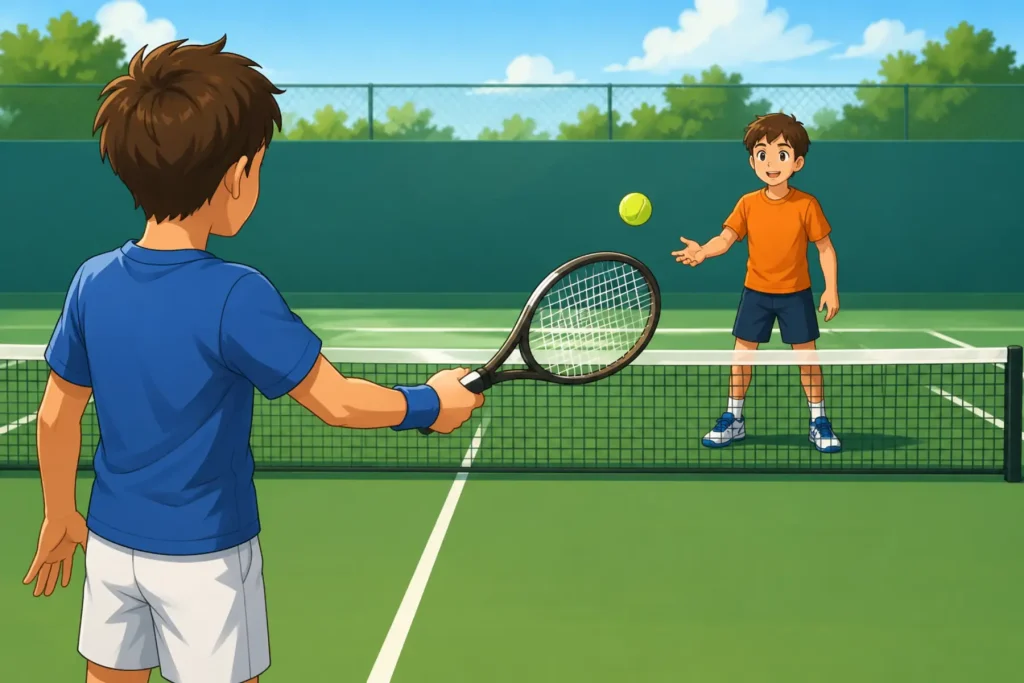
When the Next Step Depends on You
A company sends a proposal to a client. The team has explained the price, answered the questions, and attached the final document. At this point, they cannot move forward until the client answers. One person says:
We’ve done our part. The ball is in their court now.
The image comes from court games like tennis: when the ball is on your side, you need to hit it back. The phrase is usually not about sport. It means: someone has passed the responsibility for the next action to you.
The Moment People Usually Say It
People use the ball is in your court idiom when one side has already taken action and is now waiting.
It sounds natural after:
- someone sends documents;
- someone makes an offer;
- someone gives several options;
- someone apologizes;
- someone explains their position;
- someone asks for a decision.
For example:
I’ve sent the updated contract. The ball is in your court now.
This works because the speaker has done something first. The other person now needs to read, decide, sign, approve, or reply.
In a less formal situation, it could be about plans:
I suggested three restaurants. The ball is in your court.
The Ball Is in Your Court: Sentences That Show the Meaning Clearly
- I’ve sent the proposal, so the ball is in your court now.
- We made a fair offer. The ball is in their court.
- She apologized yesterday, and now the ball is in his court.
- I gave you three dates for the meeting. The ball is in your court.
- My tutor gave me feedback, so the ball is in my court now. I need to revise the essay.
- The customer has the form. Once they sign it, the ball will be in our court.
- They asked for more information, we sent it, and now the ball is back in their court.
- You said you needed time to think. That’s fine – the ball is in your court.
- The university accepted your application, so the ball is in your court now.
- We’ve done everything we can from our side. The ball is firmly in their court.
Small Changes That Native Speakers Make
|
Common phrase |
Natural context |
|
The ball is in your court now. |
You are waiting for someone’s reply or decision |
|
The ball’s in your court. |
Casual spoken English after giving someone a choice |
|
The ball is in my court. |
You now need to act, answer, or choose |
|
The ball is in their court. |
Your side has done its part |
|
The ball is back in our court. |
Responsibility has returned to you |
|
The ball is squarely in your court. |
The responsibility is very clearly yours |
The grammar pattern is:
The ball is in + possessive adjective + court
You can say my court, your court, his court, her court, our court, their court.
The ball’s in your court has the same meaning as the ball is in your court, but it sounds more relaxed and conversational.
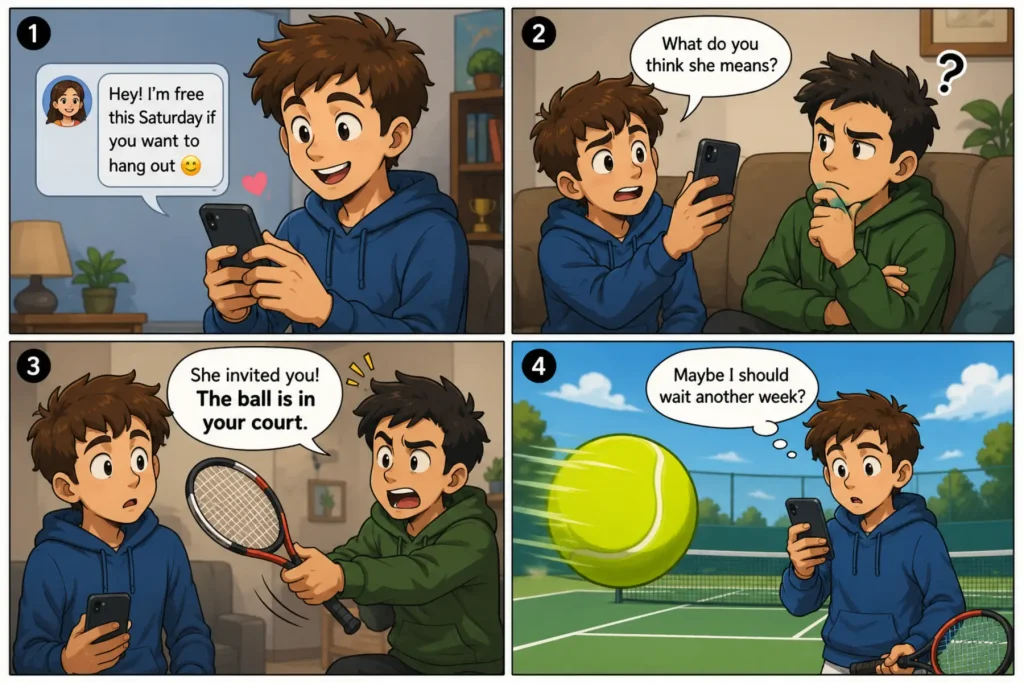
When the Hint Is Obvious
A Short Workplace Dialogue
Two colleagues have finished their part of a client proposal.
Maya: Did you send the final version?
Leo: Yes, yesterday afternoon.
Maya: And the budget explanation?
Leo: Included. I also added the new timeline.
Maya: Good. So we’re not missing anything from our side?
Leo: No. The ball is in their court now.
Maya: Then we wait for their decision.
Want more real English like this?
I share practical phrasal verbs, idioms, natural expressions, common mistakes, and short English quizzes on Telegram — in the same clear, everyday style.
Mistakes That Make the Idiom Sound Wrong
Mistake 1: The ball is on your court.
- Correct: The ball is in your court.
- Why: The fixed phrase uses in, not on.
Mistake 2: Ball is in your court.
- Correct: The ball is in your court.
- Why: The idiom normally needs the ball.
Mistake 3: The ball is in you court.
- Correct: The ball is in your court.
- Why: Use a possessive adjective: my, your, his, her, our, their.
Mistake 4: I haven’t sent the details yet, so the ball is in your court.
- Correct: I’ll send the details first. Then the ball will be in your court.
- Why: Usually, one side acts first. Only after that does the next step move to the other person.
Mistake 5: The ball is in your field.
- Correct: The ball is in your court.
- Why: Court is part of the idiom. Replacing it makes the phrase unnatural.
Phrases Learners Often Mix Up
It’s your turn
- Both can mean that someone should do something next.
- Difference: It’s your turn is often simple turn-taking; the ball is in your court usually adds responsibility.
- Example: It’s your turn to speak. / I’ve replied to the client, so the ball is in their court.
Pass the buck
- Both phrases are connected to responsibility.
- Difference: Pass the buck means avoiding responsibility and giving it to someone else. It is negative.
- Example: Stop passing the buck and make a decision.
Better Alternatives in Different Situations
It’s up to you (You decide)
- Difference: It is more general and does not always mean someone else has already acted.
- Example: It’s up to you whether we leave today or tomorrow.
Your move (You need to act next)
- Difference: It is shorter and can sound more direct, dramatic, or challenging.
- Example: I’ve made my offer. Your move.
The next step is yours (You need to continue the process)
- Difference: It is clearer and safer in formal emails.
- Example: We’ve completed the review, so the next step is yours.
The Opposite Idea
It’s out of my hands (I cannot control what happens next)
- Difference: The ball is in your court gives responsibility to someone; it’s out of my hands removes control from the speaker.
- Example: I submitted the request, but now it’s out of my hands.
Practice Time!
Task 1: Context Match
You sent a client three possible dates for a meeting. They have not chosen one yet. Which sentence fits best?
- A) The ball is in their court now.
- B) It’s out of their hands now.
- C) They passed the buck now.
Task 2: Analyze the Meaning
Read the situation below. Is the idiom used naturally here? Why or why not?
- “I haven’t emailed the price list yet, but the ball is in your court.”
Task 3: Professional Tone
Choose the best sentence for a friendly, informal message to a colleague:
- A) I’ve added my comments to the document, so the ball is in your court when you have time.
- B) I’ve added my comments to the document, so pass the buck when you have time.
Task 4: Error Correction
Find and correct the mistake in the sentence below:
- “The ball is on her court after we sent the contract.”
Task 5: Sensitivity Check
Which sentence sounds softer and more appropriate in a sensitive personal situation (e.g., after an argument with a friend)?
- A) I apologized, so the ball is in your court now.
- B) I’ve said how I feel, so I’ll give you some time to think.
Task 6: Shifting to Formal Register
Choose the best alternative to use in a formal business email to a corporate client:
- A) Your move.
- B) The next step is for you to review the attached document.
- C) The ball’s in your court, buddy.
Task 7: Nuances of Tone
What is the difference in tone between these two statements?
- Statement 1: The ball is in your court now.
- Statement 2: The ball is firmly in your court now.
Answer key:
- Task 1: A – because the client received the options and must now take action or choose the next step.
- Task 2: Not natural – because the speaker has not completed their own part of the job yet (they haven’t sent the price list), so the responsibility cannot be on the other person.
- Task 3: A – because it is a friendly, idiomatic way to pass a task to a colleague without sounding demanding.
- Task 4: The ball is in her court after we sent the contract. (The idiom always uses the preposition “in,” never “on”).
- Task 5: B – because Option A can sound pushy, demanding, or defensive in a personal relationship, while Option B gives the other person comfortable space.
- Task 6: B – because formal emails require clear, neutral, and literal language. Option A is too dramatic, and Option C is far too informal.
- Task 7: Adding the adverb “firmly” makes the statement much stronger, increasing the psychological pressure and emphasizing that the other person is completely responsible for what happens next.