Miss the Boat Meaning: When a Chance Has Already Passed
Miss the boat meaning: to lose a good opportunity because you waited too long or acted too late.

- The Meaning Behind “Miss the Boat”
- When This Idiom Fits Naturally
- Examples of “Miss the Boat” in a Sentence
- Common Phrases and Grammar Patterns with “Miss the Boat”
- Too Late for the Dream Job
- A Short Dialogue with “Miss the Boat”
- Avoid These Mistakes
- Don’t Confuse It with “Miss the Point”
- Similar Expressions to “Miss the Boat”
- Opposite or Contrast Expressions
- Practice Time!
- Quick recap
The Meaning Behind “Miss the Boat”
You wanted to buy concert tickets. They were available last week, but you kept thinking, “I’ll do it later.” Today you open the website, and every ticket is gone. Your friend looks at you and says, “You missed the boat.”
The idiom miss the boat means that you had a chance to do something, but you did not act in time, so the chance is gone now.
The image is easy to understand. A boat leaves the dock. If you arrive after it has left, you cannot get on. In everyday English, the “boat” is usually not a real boat. It is a chance: a job opening, a discount, a ticket, an application, a business trend, or an investment opportunity.
The idiom is not about every kind of failure. It is about timing. The chance was there, but the moment to take it has gone.
When This Idiom Fits Naturally
People use miss the boat when a situation has a clear window of opportunity. There was a good time to act, but someone waited, hesitated, forgot, or moved too slowly.
You can use it for small everyday things:
“The sale ended last night. I missed the boat.”
You can also use it for bigger decisions:
“We missed the boat on expanding into that market.”
The phrase is especially natural with deadlines and limited chances. A student remembers a scholarship application one day late. A family waits too long to book cheap flights. A company ignores a new technology until competitors are already ahead. In all of these cases, the same idea appears: the chance was open, then it closed.
A quick example:
Lena saw a course with an early-bird price, but she wanted to compare other options first. Two days later, the price doubled. She tells her friend, “I should have signed up earlier. I missed the boat.”
This is a natural way to use miss the boat in English because the problem is not just “I made a mistake.” The problem is “I acted too late.”
Examples of “Miss the Boat” in a Sentence
- I wanted to buy tickets for the show, but they sold out yesterday. I missed the boat.
- She missed the boat on the job opportunity because she applied after the deadline.
- Don’t miss the boat – the early-bird price ends tonight.
- We missed the boat on buying that apartment when prices were still low.
- The company missed the boat by ignoring online sales for too long.
- Have I missed the boat, or can I still register for the course?
- He nearly missed the boat, but he sent the application ten minutes before the deadline.
- They missed the boat on that investment, and now the price is much higher.
- You haven’t missed the boat yet. The deadline is tomorrow, so apply today.
- I think we missed the boat with that product launch. Our competitors moved much faster.
Common Phrases and Grammar Patterns with “Miss the Boat”
|
Common phrase |
How it works |
Natural context |
|
miss the boat |
Main form of the idiom |
Use it when someone may lose a chance if they do not act soon: “Book today, or you’ll miss the boat.” |
|
missed the boat |
Past form |
Use it when the opportunity is already gone: “The sale ended yesterday, so I missed the boat.” |
|
miss the boat on something |
Names the missed opportunity |
Use on + noun when you want to say exactly what chance was lost: “We missed the boat on the early discount.” |
|
miss the boat on doing something |
Names the missed action |
Use on + -ing when the opportunity was connected to an action: “I missed the boat on buying tickets.” |
|
miss the boat by doing something |
Explains why the chance was lost |
Use by + -ing to show the action or delay that caused the problem: “He missed the boat by waiting too long.” |
|
don’t miss the boat |
Warning or reminder |
Use it before the chance disappears: “Don’t miss the boat – registration closes tonight.” |
|
haven’t missed the boat yet |
Reassurance |
Use it when there is still time to act: “You haven’t missed the boat yet; applications close tomorrow.” |
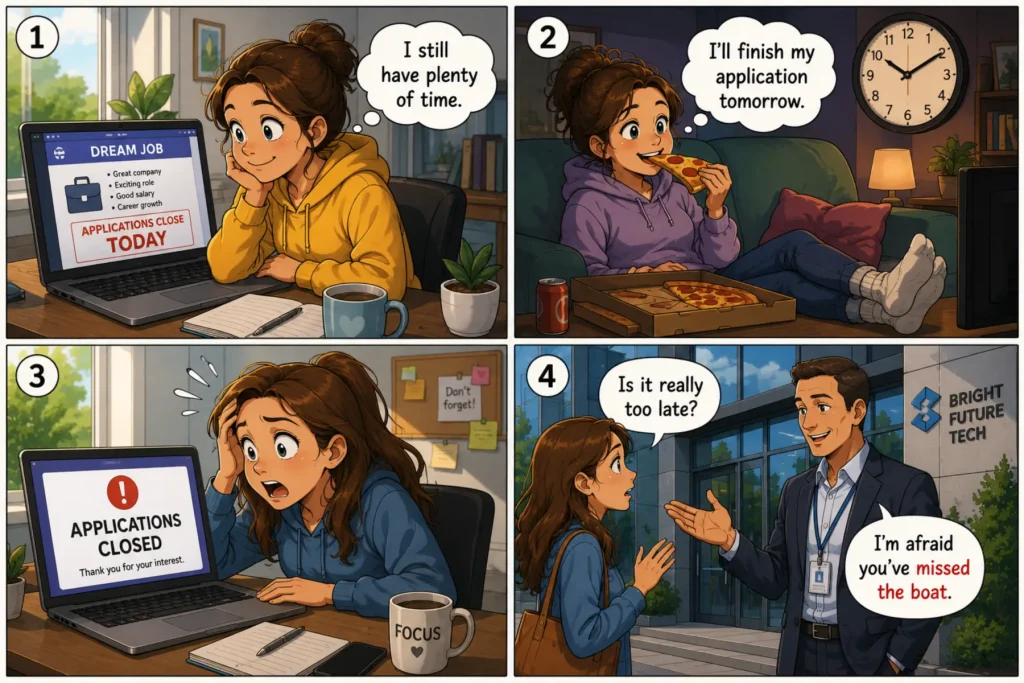
Too Late for the Dream Job
A Short Dialogue with “Miss the Boat”
Two colleagues are talking about an internal job opening that closed yesterday.
Maya: Did you apply for the team lead role?
Ben: No, I was still thinking about it. Why?
Maya: The deadline was yesterday. I think you’ve missed the boat.
Ben: Really? I thought applications were open until Friday.
Maya: They changed the deadline last week. It was in the update email.
Ben: Ah, that’s frustrating. I should’ve checked it properly.
Maya: You’d have been a strong candidate. Next time, don’t wait too long.
Want more real English like this?
I share practical phrasal verbs, idioms, natural expressions, common mistakes, and short English quizzes on Telegram — in the same clear, everyday style.
Avoid These Mistakes
Mistake 1: Saying “miss a boat”
- Wrong: “I missed a boat on that job opportunity.”
- Correct: “I missed the boat on that job opportunity.”
- Why: The idiom is fixed: miss the boat. “Miss a boat” usually sounds literal, as if you failed to catch a real boat.
Mistake 2: Saying “lost the boat”
- Wrong: “I lost the boat because I applied too late.”
- Correct: “I missed the boat because I applied too late.”
- Why: English uses miss when you fail to catch, reach, attend, or use something in time.
Mistake 3: Using “of” after the idiom
- Wrong: “We missed the boat of that opportunity.”
- Correct: “We missed the boat on that opportunity.”
- Why: The natural pattern is miss the boat on + noun or miss the boat on + -ing.
Don’t Confuse It with “Miss the Point”
Miss the point
- Both expressions use miss, and both suggest that something important did not happen.
- Difference: Miss the point means you did not understand the main idea. Miss the boat means you lost a chance by acting too late.
- Example: “You’re talking about the color of the website, but you’re missing the point – customers can’t find the checkout button.”
Similar Expressions to “Miss the Boat”
Miss out
- Meaning: to fail to get or experience something good.
- Difference: Miss out is broader. It can happen because of choice, bad luck, illness, or timing. Miss the boat focuses more strongly on being too late.
- Example: “I missed out on the trip because I was sick.”
Miss an opportunity
- Meaning: to fail to use a chance.
- Difference: This is more neutral and more formal than miss the boat.
- Example: “The company missed an opportunity to enter the market early.”
The ship has sailed
- Meaning: the opportunity is already gone.
- Difference: This phrase focuses on the fact that it is too late now. Miss the boat often suggests that someone waited too long.
- Example: “I wanted to apply for that role, but the ship has sailed.”
Opposite or Contrast Expressions
Act in time
- Meaning: to do something before it is too late.
- Difference: This is the opposite idea of missing the boat.
- Example: “She acted in time and got the last available place.”
Take advantage of an opportunity
- Meaning: to use a chance while it is available.
- Difference: This focuses on successfully using the chance instead of losing it.
- Example: “They took advantage of the early discount and saved a lot of money.”
Practice Time!
1.Choose the best response
Your colleague says:
“The company offered free training last month, but I didn’t sign up. Now the program is full.”
What is the most natural response?
A. “You missed the point.”
B. “You missed the boat.”
C. “You missed a boat.”
D. “You missed your mind.”
2.Choose the better sentence for the situation
A student is worried because the scholarship deadline is tomorrow.
A. “You missed the boat.”
B. “You haven’t missed the boat yet, but you need to apply today.”
3.Match the sentence to the meaning
- “We missed the boat on that trend.”
- “We missed the boat by waiting too long.”
- “Don’t miss the boat on early registration.”
Meanings:
A. A warning before the chance disappears.
B. The missed opportunity was a trend.
C. The reason for losing the chance was delay.
4.Fix the sentence naturally
“The team missed the boat of investing in the new market early.”
5.Decide if the idiom is natural here
“I didn’t understand the main idea of the article. I missed the boat.”
6.Choose the sentence with the right tone
A manager is speaking to the whole team in a calm, professional way after a lost business opportunity.
A. “You all missed the boat because you were too slow.”
B. “It looks like we missed the boat on this opportunity.”
7. Complete the sentence with on or by
- “They missed the boat ___ the early discount.”
- “She missed the boat ___ sending the form a day late.”
- “We missed the boat ___ hiring him before another company made an offer.”
Answer key:
- B – “You missed the boat.” The person lost a real opportunity because they did not act while it was available.
- B – “You haven’t missed the boat yet…” The deadline has not passed, so the chance is still open.
- 1-B, 2-C, 3-A. On names the opportunity; by explains the reason; don’t miss the boat works as a warning.
- “The team missed the boat on investing in the new market early.” Use miss the boat on + -ing for the missed action.
- Not natural. The better sentence is: “I didn’t understand the main idea of the article. I missed the point.” Miss the boat is about losing an opportunity, not misunderstanding.
- B – “It looks like we missed the boat on this opportunity.” It sounds less blaming and more professional.
- 1. on, 2. by, 3. on. Use on to name the opportunity; use by to explain what made someone too late.